


The Deadly Fish Industry
Cruelty on a massive scale
Whether raised in intensive fish farms or caught in the wild, fish receive little legal protection against cruel treatment and inhumane slaughter. Far from the mindless creatures they are often portrayed to be, fish form complex social relationships, use tools, and experience pain, fear and distress. Yet the fishing and aquaculture industries treat them as commodities rather than sentient beings deserving of protection.
The Natural Life
of Fish
In the wild, fish explore vast habitats, navigate changing currents, search for food, avoid predators and interact with members of their own and other species. Some live in complex social groups, while others defend territories, form lasting associations or undertake remarkable migrations across oceans. Their lives are shaped by the freedom to move, respond to their surroundings and carry out the behaviours essential to their survival. Understanding this natural world reveals just how much is lost when fish are reduced to commodities.
01 / OCEAN LIFE
A World Beneath the Waves
Oceans cover more than 70 per cent of the Earth's surface, creating vast habitats that support extraordinary diversity of life. From vibrant coral reefs and kelp forests to rivers and the open ocean, fish have evolved to thrive in an incredible range of environments.
02 / ANCIENT ORIGINS
Hundreds of Millions of Years in the Making
Fish have an extraordinary evolutionary history stretching back hundreds of millions of years. Today, more than 32,000 recognised fish species inhabit our planet, outnumbering all other vertebrate groups combined. Their remarkable diversity reflects an ancient history of adaptation and survival.
03 / A VANISHING WORLD
An Ocean Under Pressure
Earth's oceans have endured five mass extinction events, and scientists warn that human activity is driving a sixth. Overfishing, habitat destruction and other human pressures threaten marine ecosystems and the extraordinary diversity of life they sustain.
Can Fish Feel Pain?
In her book Do Fish Feel Pain?, biologist Victoria Braithwaite says that “there is as much evidence that fish feel pain and suffer as there is for birds and mammals.”
Fish have specialised sensory receptors called nociceptors, which detect potentially damaging stimuli such as extreme temperatures, harmful chemicals and physical injury. In a landmark study published in Proceedings of the Royal Society B, researchers identified these receptors in rainbow trout and found that exposing fish to painful stimuli caused measurable changes in their physiology and behaviour. The affected fish showed increased gill movements, rubbed their lips against tank surfaces and took significantly longer to resume feeding. These responses persisted beyond an immediate withdrawal reflex, providing evidence that the effects of injury extend beyond a simple, momentary reaction.
Further evidence comes from studies investigating the effects of pain-relieving medication. When rainbow trout were exposed to potentially painful chemicals, they displayed abnormal behaviours, including rubbing their mouths against surfaces and rocking from side to side. Treatment with morphine reduced these behaviours and lowered their elevated breathing rates. Other research has found that painful stimulation can disrupt normal activities, including feeding and responses to unfamiliar objects. Together, these findings suggest that fish do not simply detect harmful stimuli: the resulting state can affect their behaviour and priorities, and can be alleviated by analgesic drugs.
Fish can also learn to avoid situations associated with harmful experiences, and their responses can persist beyond the immediate event. A comprehensive scientific review published in 2019 examined evidence from fish neurobiology, physiology and behaviour, concluding that fish are highly likely to experience pain. Although researchers continue to debate the precise nature of conscious experience in fish, the absence of human-like brain structures does not establish an inability to feel pain. The growing body of evidence gives us compelling scientific grounds to take fish suffering seriously and to question practices such as hooking, handling and slaughter that can cause injury and distress. Fish do not need to cry out or express pain as humans do for their suffering to deserve consideration.
Are Fish Smart?
Fish are far more cognitively capable than many people realise. Different species demonstrate learning, memory, spatial navigation, problem-solving and sophisticated responses to their surroundings.
01
Learning & Memory
Different species demonstrate learning, memory, spatial navigation, problem-solving and sophisticated responses to their surroundings.
02
Social Intelligence
Some fish recognise individuals, learn from experience and adjust their behaviour according to social relationships.
03
Complex Interactions
Cleaner fish navigate complex interactions with other species, while certain fish learn routes through challenging environments.
04
Tool Use
Fish intelligence varies enormously between species, and it does not need to resemble human intelligence to matter.
How Fish Are Caught or Farmed
Two Industries, One Exploited Population
Commercial fish production takes two main forms: capture fishing, which removes wild fish from oceans, seas, rivers and lakes, and aquaculture, which raises fish in controlled freshwater or marine environments. Although fish farming is often promoted as a solution to overfishing, many farmed species depend on feed made from wild-caught fish, placing further pressure on marine ecosystems.

Farmed Fish
Aquaculture
Wild-Caught Fish
Capture Fishing
In 2020, global fisheries and aquaculture production reached approximately 178 million tonnes.
90 million tonnes came from capture fisheries, accounting for around 51 per cent of the total.
88 million tonnes came from aquaculture, representing approximately 49 per cent.
Types of Commercial Capture Fishing
Commercial fishing uses a range of methods to catch wild fish and other marine animals on an industrial scale. From massive trawler nets dragged across the seabed to longlines carrying thousands of baited hooks, each technique brings its own risks to marine life. Bycatch, habitat destruction and the capture of non-target species are among the serious consequences of these fishing methods.
Trawlers
Trawlers tow large nets through the sea, sometimes along the seabed. Bottom trawling can damage marine habitats, disturb seabed ecosystems and capture animals that were never intended to be caught. Fish caught in trawl nets may be crushed, injured or exhausted as large catches are hauled aboard.
01 / 03
Long-liners
Longline fishing uses a main line carrying many baited hooks, which can extend for kilometres. It is used to catch species such as tuna, swordfish and other commercially valuable fish. Sharks, seabirds, turtles and other marine animals can also become hooked, causing injury or death.
02 / 03
Purse Seiners
Purse seiners surround schools of fish with a large net that closes underneath like a drawstring bag. When catches are crowded together, fish can experience compression, injury and oxygen deprivation. The environmental impact depends on the species targeted, fishing practices and the use of fish-aggregating devices.
03 / 03
Three Threats to Marine Life
Overfishing
Overfishing occurs when fish are caught faster than their populations can naturally reproduce and recover. Driven by growing demand for seafood and increasingly intensive fishing practices, it depletes fish populations, threatens vulnerable species and disrupts marine food webs. The decline of large predators, including sharks, tuna and swordfish, can have far-reaching consequences for ocean ecosystems. As fishing pressure intensifies, fleets move into more distant waters, placing further strain on marine life and the communities that depend on healthy oceans.
Illegal Fishing
Illegal, unreported and unregulated (IUU) fishing undermines efforts to protect marine ecosystems and manage fish populations sustainably. It includes fishing in prohibited areas, catching more than permitted, concealing catches and operating where effective regulations are absent. Often hidden from effective monitoring, these practices contribute to the depletion of fish populations, threaten protected species and undermine the livelihoods of coastal communities. By allowing fishing to continue beyond legal limits and conservation measures, IUU fishing places additional pressure on already vulnerable marine ecosystems.
Bycatch
Bycatch is the unintended capture of marine animals during commercial fishing, including species that fishers do not want or are not permitted to catch. Trawl nets, longlines and purse seines can trap dolphins, whales, seals, seabirds, sharks and non-target fish alongside the intended catch. Many animals are injured or killed in the process, while unwanted fish are frequently discarded back into the sea, dead or dying. Because bycatch is often underreported, its full scale remains difficult to measure, concealing a significant toll on marine wildlife and threatening the survival of vulnerable species.
The Scale Of The Crisis
The ocean is under growing pressure from human fishing activities. Overfishing depletes marine populations, illegal fishing undermines conservation efforts, and bycatch takes the lives of animals that were never intended to be caught. Together, these threats endanger marine biodiversity, disrupt ocean ecosystems and put the future of marine life at risk.
Look a little closer
Overfishing, illegal fishing and bycatch are interconnected threats that place enormous pressure on marine ecosystems. Overfishing occurs when fish are caught faster than their populations can naturally recover, causing population declines, disrupting marine food webs and threatening the balance of ocean life. According to the FAO’s State of World Fisheries and Aquaculture 2024, 37.7% of assessed marine fish stocks were being fished at biologically unsustainable levels in 2021. These figures demonstrate the scale of the problem among assessed stocks, while many other fish populations remain insufficiently monitored.
The consequences extend throughout marine ecosystems. Large predatory fish, including sharks, tuna and swordfish, play important roles in maintaining ecological balance. Their depletion can alter predator-prey relationships and disrupt entire food webs. As fish populations decline in heavily exploited waters, commercial fleets often travel farther in search of catches, placing additional pressure on other regions and the communities that depend on them. Although fishing limits and conservation measures can help populations recover, effective rebuilding requires fishing pressure to fall to sustainable levels.
Illegal, unreported and unregulated (IUU) fishing intensifies these pressures by allowing fishing activities to escape effective oversight. It includes fishing in prohibited areas, exceeding permitted catches, concealing catches and operating without appropriate management controls. The Food and Agriculture Organization of the United Nations estimates that up to 26 million tonnes of fish are caught illegally or go unreported each year. Because fishing operations often take place far from shore and across international boundaries, monitoring and enforcement can be difficult, allowing destructive practices to continue beyond the reach of effective controls.
The consequences of illegal fishing extend beyond wildlife. It undermines conservation efforts, disadvantages fishers who follow the rules and threatens the food security and livelihoods of coastal communities. Unreported catches also make it harder for scientists and authorities to assess fish populations accurately and establish effective management measures. Without reliable monitoring, traceable supply chains and meaningful enforcement, fishing limits alone cannot adequately protect marine ecosystems.
Another major consequence of commercial fishing is bycatch, the unintended capture of animals that fishers do not intend to catch. Trawl nets, longlines and other fishing equipment can trap dolphins, whales, seals, seabirds, sharks, turtles and non-target fish. Many animals die from injuries, exhaustion or drowning, while unwanted fish are frequently discarded at sea, dead or dying. A 2020 study published in Scientific Reports estimated that marine fisheries discarded 9.1 million tonnes of catch annually, equivalent to approximately 10.8% of total catch, based on data from 2010–2014.
The impact on protected wildlife is also significant. The 2026 report Hidden in the Haul: The True Scale of Bycatch, published by Wildlife and Countryside Link, highlights the scale of the problem in UK waters. Its estimates include more than 10,000 seabirds, over 1,000 cetaceans, around 500 seals and more than 120 tonnes of protected sharks, skates and rays caught annually. The report also identifies more than 1,000 endangered Atlantic salmon. These figures relate specifically to UK waters, and limited monitoring and underreporting suggest that the actual impact may be greater.
Together, these threats reveal the wider consequences of industrial fishing: declining fish populations, disrupted ecosystems and the deaths of countless unintended victims.
Sources: FAO: The State of World Fisheries and Aquaculture 2024 · FAO: Illegal, Unreported and Unregulated Fishing · Scientific Reports: Global Fisheries Discards · Wildlife and Countryside Link: Hidden in the Haul
The hidden cost of
fish farming
Aquaculture is often presented as a solution to declining wild fish populations. Yet behind its rapid growth lies a troubling contradiction: fish farming still depends heavily on wild-caught fish, while millions of farmed fish face intensive production systems, welfare failures and premature death.
A growing industry, at what cost?
Salmon Farming
There is a diverse range of fish species farmed in the UK – carp, sea bass, salmon, trout and tuna – that are housed in a variety of extensive freshwater pond or sea cage systems with stocking densities ranging from low to high.
In the UK, we slaughter in excess of 77 million farmed fish annually,14 making fish the second largest number of farmed animals slaughtered for food, after chickens. The most commonly farmed species is the Atlantic salmon, with around one million salmon meals eaten every day in Britain.15 But as every pound of farmed salmon consumes around three pounds of wild-caught fish as food, there are far more lives lost.
Scotland is the largest producer of Atlantic salmon in the EU and the third largest global producer, with an industry worth over £2 billion (GBP).17 Of the 250 Scottish farms, around 70 per cent are certified by the RSPCA Assured scheme18 – which would suggest that high welfare standards are implemented and well-monitored. However, that’s simply not the case.
In 2026, the UK’s Information Commissioner’s Office ordered the release of Animal and Plant Health Agency (APHA) inspection reports, exposing serious welfare failures in Scottish salmon farming. These included an incident in which over one million fish died within 10 hours due to hydrogen sulphide build-up, another in which more than 100,000 fish suffocated after their oxygen supply was cut off, and separate incidents at an RSPCA-certified farm where hydrogen sulphide killed 600,000 salmon, followed months later by over 1.5 million more.
Disease and Illness in Fish Farms
Intensive fish farming can create conditions that allow diseases and parasites to spread rapidly. Crowded sea cages and ponds, poor water quality and environmental stress can weaken fish and make outbreaks harder to control. Both overcrowding and unsuitable stocking densities can compromise fish welfare.
Sea lice are a major concern in salmon farming, causing skin damage, open wounds and stress. Fish can also suffer from bacterial infections, parasites, fin injuries and other illnesses. Crowding can increase physical contact and injuries, while inadequate conditions leave fish more vulnerable to disease and distress.
The consequences extend beyond farmed fish. Disease and parasites can spread to wild populations, while faeces, uneaten feed, antibiotics, pesticides and disinfectants can pollute surrounding waters. These conditions threaten fish welfare, damage marine ecosystems and raise serious concerns about the environmental impact of intensive aquaculture.
How Fish Are Killed?
Whether caught in the wild or raised on fish farms, many fish are killed using methods that leave them struggling for oxygen. Asphyxiation in air or on ice can cause a prolonged and distressing death. Despite evidence that fish can experience pain and fear, their welfare is often given little consideration during slaughter. Commercial slaughter methods vary between species, but many involve considerable suffering before death.
Asphyxiation in Air or on Ice
Fish are removed from water and left without sufficient oxygen. Used for species including carp, seabream, seabass, trout and turbot.
Percussive Stunning After Asphyxiation
Carp may first be left out of water before being struck with a club to stun them.
Carbon Dioxide Stunning
Carbon dioxide is used to stun certain species, including salmon and trout. This method has raised serious welfare concerns.
Live Chilling
Fish are exposed to very low temperatures while still alive. This method is used for several species, including carp, salmon, seabream, seabass and trout.
Gill-Cutting Without Prior Stunning
The gills are cut without first rendering the fish unconscious, allowing it to bleed to death. This method has been reported for turbot.
Salt Immersion and Evisceration
Eels may be immersed in salt and gutted while they are likely still alive.
Can Fish Be Killed Humanely?
The European Food Safety Authority (EFSA) has warned that many existing commercial killing methods expose fish to substantial suffering over prolonged periods. For many species, it has found no commercially acceptable method capable of ensuring humane killing.
Look a little closer
In the commercial slaughter of carp, fish may be removed from water for 20 minutes or longer before being struck on the head with a metal or wooden club, sometimes known as a priest, to stun them.
During this period, they are unable to breathe normally. The practice illustrates how routine commercial procedures can expose fish to prolonged distress before slaughter. Some slaughter systems aim to render fish unconscious before killing them. These include:
Percussive stunning: a targeted blow to the head.
Electrical stunning: an electrical current intended to induce unconsciousness.
Spiking the brain: inserting a spike into the brain to cause immediate unconsciousness and death.
Spiking with sedatives: combining brain spiking with the use of fish sedatives.
The effectiveness of these methods depends on the species, equipment design and correct application. Poorly designed or improperly performed procedures can fail to prevent suffering.
Why Is Fish
Farming Bad?
Here’s why fish farms are like factory farms.
Fish Suffer on Farms
A life of pain and distress
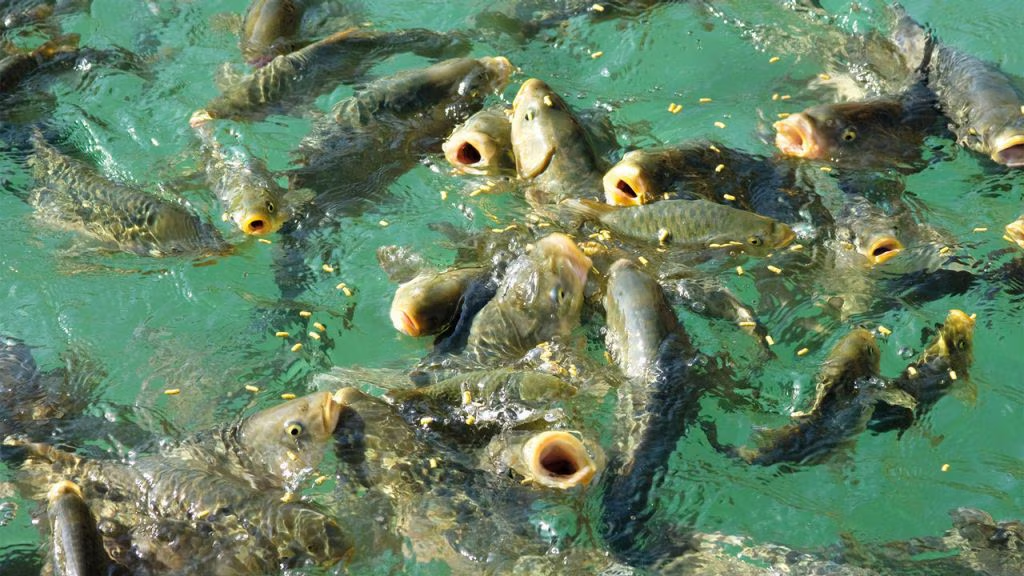
Fish are capable of experiencing pain and distress, yet their suffering is often overlooked. Undercover investigations have documented farmed fish being kicked, stomped on and thrown, while others are left to suffocate out of water. Wild-caught fish also endure extreme physical stress when hauled from the ocean in nets and left struggling for oxygen. On fish farms, these conditions can continue throughout their lives, ending in slaughter methods that often cause prolonged suffering.
Thousands of Fish Confined in Crowded Spaces
Life without room to move
Industrial fish farms confine tens of thousands of fish in tanks and ocean pens, leaving them with limited space to move freely. Overcrowding can increase aggression, injuries, disease transmission and stress, while affecting feeding and normal behaviour. This confinement stands in stark contrast to the lives of wild fish, such as salmon, which can travel hundreds of miles during their migrations.
Fish Farms Spread Disease and Parasites
Infections in crowded waters
Crowded conditions and poor water quality can leave farmed fish vulnerable to bacterial infections and parasites, including sea lice. These infestations can cause skin damage, scale loss and death. Disease outbreaks can also threaten wild fish populations when pathogens spread beyond farms. Antibiotics used to control infections raise further concerns about environmental contamination and the growing problem of antimicrobial resistance.
Fish Farming Damages Marine Ecosystems
The impact beyond the cages
Open-net fish farms allow waste, uneaten feed, parasites and pathogens to pass directly into surrounding waters. Escaped farmed fish can spread disease and interbreed with wild populations, potentially affecting their genetic diversity and survival. The environmental consequences extend beyond the cages, placing additional pressure on marine ecosystems already affected by human activity.
Fish Farming Exploits People and Communities
The hidden human cost
The impacts of industrial fish farming extend beyond animals and ecosystems. Reports of labour violations on fish farms raise concerns about low wages, excessive working hours and inadequate protection for vulnerable workers. The industry also relies on fishmeal and fish oil made from wild-caught fish, including small species harvested in food-insecure regions. These fish are diverted from local food systems to feed farmed salmon destined for wealthier markets, raising serious questions about global food justice.
Farmed Fish Are Killed in Cruel Ways
A distressing end to their lives
The suffering of farmed fish does not end when they are removed from their tanks or sea cages. Many are killed through asphyxiation in air or on ice, methods that can leave them conscious and distressed for prolonged periods. Other commercial methods may also fail to render fish unconscious before slaughter. Although stunning techniques are available, their effectiveness depends on the species, equipment and correct application. Without effective procedures, fish can experience pain and fear during their final moments.
The Global Scale of Fish Farming
Behind the seafood on our plates lies a vast global industry.
An estimated 124 billion farmed fish were killed for food worldwide in 2019, with the actual figure potentially ranging from 78 to 171 billion. These staggering numbers reveal the immense scale of fish farming and its impact on aquatic animals.
Source: Animal Welfare study
Global aquaculture produced 103 million tonnes of aquatic animals in 2024.
Source: FAO, SOFIA 2026
Aquaculture accounted for 53% of global aquatic animal production in 2024.
Source: FAO, SOFIA 2026
In 2024, global capture fisheries extracted around 92 million tonnes of aquatic animals from the wild, while fish farming continued to expand. Yet this expansion comes at a cost: 37.7% of assessed marine fish stocks were overfished in 2021, according to the FAO. Aquaculture also creates its own pressures. Many farmed species rely on feed containing fishmeal and fish oil derived from wild-caught fish, adding further demand for marine life.
Discover the Reality
Behind the Fishing Industry.
The Fishing Industry’s...
References & Further Reading
Explore scientific research and expert reports on dairy farming, animal welfare and plant-based alternatives to make informed, compassionate choices.
Organisations & Data
Scientific Reviews
- Impacts of Biodiversity Loss on Ocean Ecosystem Services
- Humane stunning or stun/killing in the slaughter of wild-caught finfish
- Fish welfare during slaughter
- Electro-Immobilisation and Fish Welfare
- Pain Recognition in Fish
- Pain and stress responses in farmed fish
- Wild Fish Welfare in UK Commercial Sea Fisheries
- Global patterns of marine mammal, seabird, and sea turtle bycatch reveal taxa-specific and cumulative megafauna hotspots
- Impacts of fisheries bycatch on marine turtle populations worldwide
Further Reading
Why Go Vegan?
Explore the ethical, environmental, and health reasons for choosing a vegan lifestyle.
How to Go Vegan?
A practical, step-by-step guide to making the transition to a healthy vegan diet.
How to Stay Vegan?
Practical strategies and tips to make vegan living enjoyable, balanced, and sustainable long-term.


