


About pigs
Intelligent, Emotional Pigs
“[Pigs] have the cognitive ability to be quite sophisticated. Even more so than dogs and certainly three-year-olds.”
Professor Donald Broom
Oxford University
10 Amazing Facts About Pigs
Did you know that pigs like to cuddle?
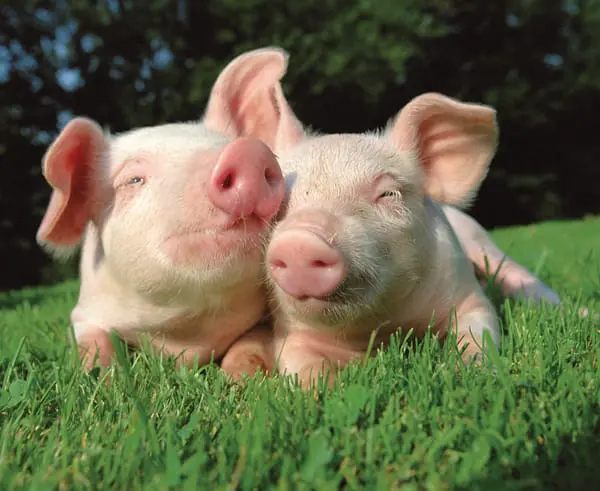
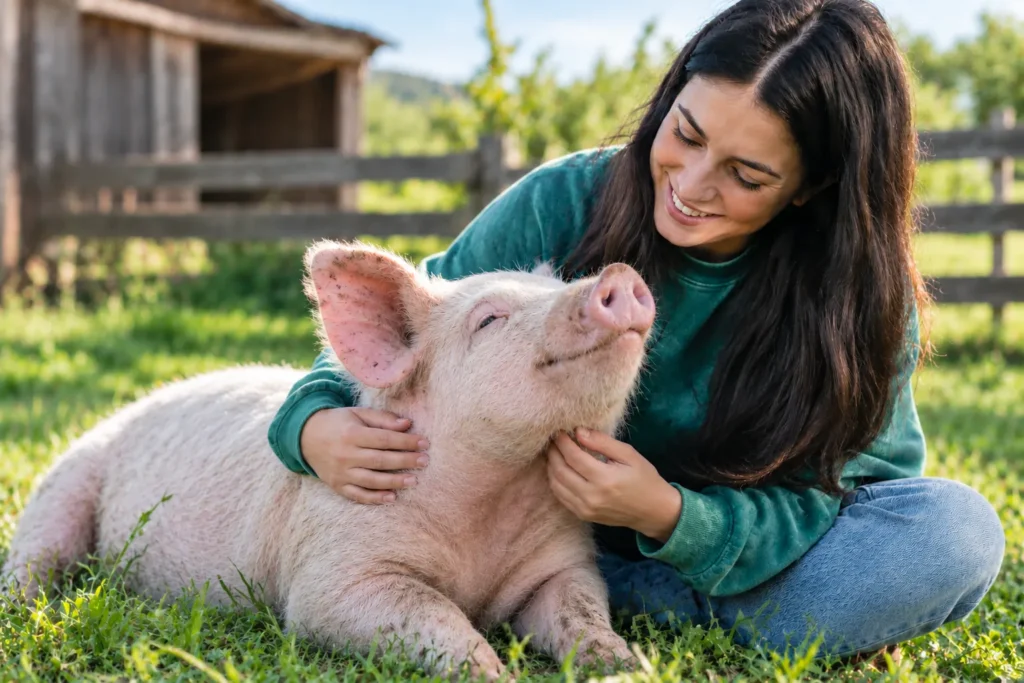
Tip: The best way to observe pigs' natural behaviour is to visit a farm sanctuary where they can live freely, express their natural instincts and enjoy life without fear of slaughter. See for yourself what a natural day in a pig's life looks like.
Factory Farming
Pigs Used for Meat
 01 / INDUSTRIAL PRODUCTION
Slaughter on an Enormous Scale
Every year, hundreds of millions of pigs are raised and slaughtered around the world for human consumption. Their meat is sold in countless forms, including bacon, ham, sausages and other pork products.
To meet global demand, pig farming has increasingly become an intensive industry, where large numbers of animals are raised in highly controlled environments.
In these systems, every stage of a pig's life is organised around production: how quickly they grow, how much they eat and how often they reproduce. Their individual needs and natural behaviours are too often overlooked.
Behind every number is an individual animal. 02 / CONFINEMENT
A Life of Confinement
Pigs are naturally active, curious animals with a strong desire to explore, root in the ground and interact with one another. Yet in many intensive farming systems, they spend most or all of their lives indoors in crowded enclosures.
Often kept on concrete or slatted floors with little or no bedding, they have limited opportunities to investigate their surroundings or express their natural behaviours.
Without enough space or suitable materials to explore, pigs may develop repetitive behaviours such as biting bars, chewing without food or repeatedly rubbing their snouts against the floor.
A life without the freedom to behave naturally. 03 / BREEDING SOWS
The Desperate Cycle of a Breeding Sow
The life of a breeding sow in intensive pig farming is often an exhausting cycle of pregnancy, birth and nursing. Female pigs may spend much of their adult lives being repeatedly impregnated and expected to raise one litter after another.
In some farming systems, pregnant sows are kept in individual confinement stalls, commonly known as gestation crates.
These narrow metal enclosures restrict their movement so severely that they may be unable to turn around freely or walk away from where they rest. For social animals that naturally seek space and companionship, this can mean prolonged physical and psychological distress.
Her life becomes a cycle dictated by production. 04 / REPRODUCTION
Artificial Insemination
Artificial insemination is widely used in commercial pig production. It allows farmers to control breeding and select particular genetic traits without keeping breeding males on every farm.
Although the procedure itself varies, it is part of a production system in which the reproductive lives of female pigs are carefully managed to maximise efficiency.
Rather than choosing when and with whom to reproduce, sows are bred according to the demands of the industry, with little consideration for their natural social and reproductive behaviour.
Even reproduction becomes an industrial process. 05 / GESTATION CRATES
Imprisoned During Pregnancy
Gestation crates are designed to keep pregnant sows individually confined. Made of metal bars, these stalls offer so little space that the animals may be unable to turn around or move freely.
In large industrial facilities, rows of these crates can fill enormous indoor buildings.
The hard, often slatted floors can contribute to discomfort, injuries and mobility problems. Restricted movement and a lack of stimulation can also lead to boredom, frustration and abnormal repetitive behaviours.
Pregnancy should not mean a life in a cage. 06 / MOTHERHOOD
Nursing Piglets in Industrial Stalls
Shortly before giving birth, sows may be moved into farrowing crates. These enclosures are designed to reduce the risk of piglets being accidentally crushed, but they severely restrict the mother's movement.
In natural conditions, a pregnant sow would seek a quiet place and build a nest using grass, leaves and other materials before giving birth.
In a farrowing crate, she may be unable to turn around, move away from her piglets or properly express her natural maternal behaviours. Her ability to interact with and care for her young is restricted.
A mother should be free to care for her babies. 07 / PAINFUL PROCEDURES
Castrated and Tail-Docked Without Relief
In many intensive farming systems, piglets undergo painful procedures at a very young age. Male piglets may be surgically castrated to prevent unwanted reproductive behaviour and reduce the risk of boar taint in meat.
Their tails may also be docked to reduce the risk of tail biting, a behaviour that can develop in stressful, overcrowded and unstimulating environments.
These procedures cause pain and distress, particularly when performed without appropriate anaesthesia and pain relief. Better living conditions and suitable enrichment can help address the underlying causes of tail biting.
Their pain is often treated as part of production. 08 / GROWING UP
The Endless Cycle
After weaning, piglets are separated from their mothers and moved into rearing and fattening facilities. There, their feeding and growth are closely controlled until they reach the weight required for slaughter.
Meanwhile, breeding sows are often impregnated again shortly after their piglets are weaned, beginning another cycle of pregnancy and nursing.
This continues until their reproductive performance declines and they are no longer considered economically productive. They are then sent to slaughter, just like the pigs they have given birth to.
Born, raised, and bred again — all for production. 09 / TRANSPORT & SLAUGHTER
Transport and Slaughter
When pigs reach the desired market weight, they are loaded onto trucks and transported to slaughterhouses. For animals that have spent their lives in familiar surroundings, the noise, handling, mixing with unfamiliar pigs and journey itself can be frightening and stressful.
Transport can also expose pigs to exhaustion, injuries and extreme temperatures. Animals that are already weak, sick or unable to walk may be particularly vulnerable.
At the slaughterhouse, they face further handling and the final stage of a life in which almost every decision has been made for them.
They deserve more than a life measured by weight. 10 / ENVIRONMENTAL IMPACT
The Environmental Cost
The impact of intensive pig farming extends beyond the animals themselves. Large concentrations of pigs produce enormous quantities of manure and wastewater, which must be stored and managed.
When poorly handled, these wastes can pollute rivers, groundwater and soil, while releasing gases that affect air quality and contribute to environmental problems.
The consequences can reach beyond farm boundaries, affecting nearby communities, ecosystems and other animals. Factory farming is therefore not only an animal welfare issue, but also an environmental concern.
The consequences extend far beyond the farm.Slide 1 of 10
How Pigs Are Killed
The Truth Behind Bacon
Behind the pork industry lies a reality of confinement, distress and suffering for millions of pigs.
United Kingdom
11.4 million
Approximately 11.4 million pigs were slaughtered in the United Kingdom in 2022.
Global
1.49 billion
Approximately 1.49 billion pigs were slaughtered worldwide in 2022.
Two Different Realities
Two Very Different Lives
The same intelligent, sensitive animal. Two profoundly different realities. Discover the contrast between a pig's natural life and the conditions experienced by many pigs in intensive farming systems.
A Natural Life
Freedom to Be a Pig
Exploring, playing, socialising and expressing natural instincts in a safe and enriching environment.
Nature. Freedom. Connection.
Factory Farming
A Life of Confinement
Restricted movement, limited stimulation and daily life shaped around production.
Confinement. Control. Production.


