
TL;DR:
- Vitamin B12 is absent from unfortified plant foods, making supplementation essential for vegans. Adequate B12 supports nerve health, red blood cell production, and DNA synthesis; deficiency can cause serious neurological and cognitive damage. Reliable sources include fortified foods and high-dose supplements, with regular testing crucial to prevent silent deficiencies.
Vitamin B12 is the one nutrient virtually absent from plant foods, making it the single non-negotiable supplement for anyone following a vegan or plant-based diet. The nutrient supports red blood cell formation, DNA synthesis, and the protective myelin sheath around your nerves. Without it, the consequences range from crushing fatigue to irreversible neurological damage. Understanding the role of vitamin B12 for vegans is not optional health trivia. It is the foundation of a safe, sustainable plant-based life.
Why vitamin B12 deficiency happens on a vegan diet
B12 is produced by bacteria, not by plants or animals. Animals accumulate it in their tissues because they consume bacteria through soil, water, and feed. Humans eating those animals absorb the stored B12 directly. When you remove animal products from your diet, that supply chain disappears entirely.

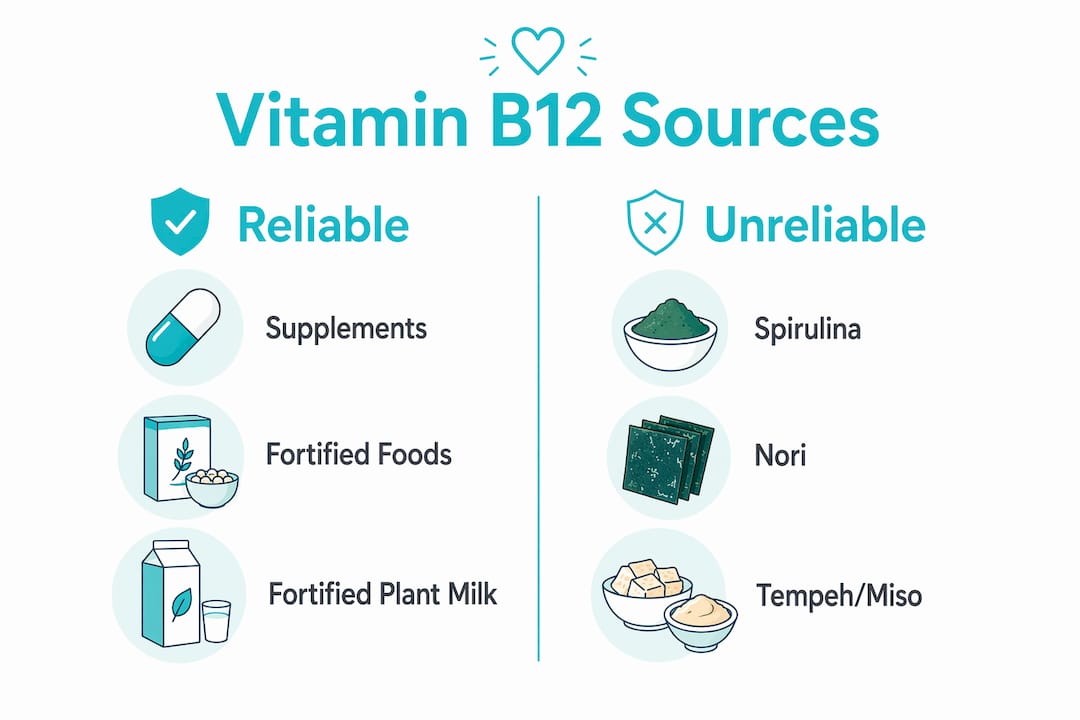
Plant foods do not reliably deliver active B12. Foods like spirulina, nori, tempeh, and miso contain , sometimes called pseudo-B12, that can interfere with true B12 metabolism rather than supplement it. Relying on these foods is one of the most common and dangerous mistakes new vegans make.
Your liver can store B12 for roughly three to five years, which is why deficiency often develops silently. Many vegans feel fine for years before symptoms appear, then face a diagnosis that feels sudden but was years in the making. without ongoing intake, and by the time symptoms surface, neurological damage may already be underway.
Absorption adds another layer of complexity. B12 requires a protein called intrinsic factor, produced in the stomach, to be absorbed efficiently. At higher supplement doses, a second absorption pathway kicks in, but it captures only about 1% of the dose passively. This is why higher supplement doses are needed than the physiological minimum, and why daily or weekly high-dose regimens are the standard recommendation.
Pro Tip: If you have been vegan for more than two years without supplementing, get your B12 tested before assuming your stored levels are still adequate. Serum B12 can look normal even when functional deficiency is developing.
What are the best vitamin B12 sources for vegans?
Fortified foods and supplements are the only reliable vitamin B12 sources for vegans. No unfortified plant food delivers enough active B12 to meet daily needs.
Fortified foods worth knowing
provides nearly 50% of the daily B12 requirement for adults. Fortified plant milks from brands like Oatly, Silk, and Alpro are consistent sources, though you need to check labels because not every product in every market is fortified. Nutritional yeast is another option. can provide sufficient B12, but only if the label explicitly confirms fortification. Brands like Bragg and Bob’s Red Mill offer fortified versions, while many bulk or store-brand products do not.
Some vegan meat substitutes are also fortified, but their B12 content varies widely and should not be your primary strategy.
Supplement forms compared
| Supplement form | Best for | Notes |
|---|---|---|
| Cyanocobalamin | Most adults | Most studied, stable, widely available |
| Methylcobalamin | Those with MTHFR variants | Less stable, higher doses may be needed |
| Hydroxocobalamin | Injection use, clinical deficiency | Longer retention in the body |
| Adenosylcobalamin | Combination formulas | Less common as standalone supplement |
Cyanocobalamin is the form used in most research and is the most cost-effective choice for the majority of vegans. can be as effective as injections in many cases, which means you do not need to visit a clinic to maintain healthy levels.
Adult vegans need approximately 1.5 µg of B12 daily from food, but because absorption efficiency drops at higher doses, supplement doses of 25 to 100 µg daily or 2,000 µg weekly are the standard recommendation. Weekly high-dose supplements suit people who find daily pills easy to forget.
Pro Tip: Choose a targeted B12 supplement over a broad multivitamin. Multivitamins often contain doses too low for vegans and include nutrients you may not need, while targeted supplements allow precise dosing.
What are the health risks of B12 deficiency for vegans?
The health consequences of untreated B12 deficiency follow a predictable and serious progression. Understanding them is the strongest argument for not waiting until symptoms appear.
-
Fatigue and weakness. Macrocytic anemia develops when B12 deficiency prevents normal red blood cell formation. Red blood cells become abnormally large and dysfunctional, reducing oxygen delivery throughout the body. The result is persistent fatigue that no amount of sleep resolves.
-
Neurological damage. B12 deficiency causes demyelination, the breakdown of the protective sheath around nerve fibers. Symptoms include tingling or numbness in the hands and feet, difficulty walking, memory problems, and cognitive decline. This damage can become permanent if deficiency goes untreated for long enough.
-
Cognitive dysfunction. Elevated homocysteine, a byproduct of impaired B12 metabolism, is associated with cognitive decline and increased cardiovascular risk. B12 is required to convert homocysteine into methionine, and without adequate B12, homocysteine accumulates.
-
Pregnancy and infant risk. Deficient breastmilk B12 can cause irreversible brain development issues in infants. Vegan mothers who do not supplement put their babies at serious risk of developmental delays, even if the mother herself has not yet developed obvious symptoms. Vegan parents navigating plant-based nutrition for children need to treat B12 as a non-negotiable priority from pregnancy onward.
-
Delayed diagnosis from folate masking. of B12 deficiency, particularly among vegans who eat large amounts of leafy greens and legumes. The anemia appears corrected while neurological damage continues undetected. This is one reason why standard blood tests can miss B12 deficiency in vegans, and why active B12 testing matters.
“Neurological damage from B12 deficiency can be irreversible if treatment is delayed. Early supplementation is not a precaution. It is a clinical necessity for anyone following a strict plant-based diet.” — Harvard Health
How to monitor your B12 status and supplement effectively
Testing and supplementation together form the practical backbone of B12 management for vegans. Neither alone is sufficient.
- Serum B12 testing is the standard first step, but it has limits. Pseudo-B12 from plant foods can falsely elevate serum results, and active B12 testing is advised when serum results are indeterminate or when you are in a high-risk group such as pregnancy, older age, or long-term veganism without supplementation.
- Methylmalonic acid (MMA) and homocysteine tests are functional markers that reveal whether B12 is actually working at the cellular level. Elevated MMA is a more sensitive indicator of deficiency than serum B12 alone.
- Supplement dosing for most adults falls between 25 and 100 µg daily or 2,000 µg weekly. Older adults absorb B12 less efficiently and often need doses at the higher end of this range.
- Pregnancy and breastfeeding require consistent supplementation and monitoring. Monitoring during pregnancy and lactation is critical to prevent infant brain developmental issues, and healthcare providers should be informed of your vegan diet at the first prenatal appointment.
- Confirmed deficiency is treated with weekly injections or daily high-dose oral supplements. of starting treatment, though neurological recovery can take months.
- Fortified foods as a complement, not a replacement. Two to three servings of fortified plant milk or nutritional yeast daily can contribute meaningfully to B12 intake alongside a supplement, reducing the gap between dietary intake and requirements.
For vegan athletes, B12 and energy levels in vegans are directly connected. Macrocytic anemia from deficiency limits oxygen delivery to muscles, reducing endurance and recovery. Maintaining B12 status is as important for plant-powered athletes as protein intake.
Key takeaways
Vitamin B12 is the only nutrient with no viable plant-based source, making supplementation the single most important nutritional step every vegan must take to protect long-term health.
| Point | Details |
|---|---|
| B12 is absent from plant foods | No unfortified plant food reliably provides active B12; pseudo-B12 in spirulina and nori can mask deficiency. |
| Supplement doses must be higher | Take 25 to 100 µg daily or 2,000 µg weekly because passive absorption captures only a fraction of each dose. |
| Deficiency develops silently | Liver stores last 3 to 5 years, so symptoms may not appear until serious damage has already occurred. |
| Folate masking delays diagnosis | High vegetable intake can hide anemia signs; request active B12 or MMA testing for accurate results. |
| Pregnancy demands extra vigilance | Deficient breastmilk causes irreversible infant brain damage; vegan mothers must supplement consistently from conception. |
Why I think most vegans underestimate this one nutrient
I have spoken with hundreds of people who went vegan for the right reasons and took every other aspect of their diet seriously. They tracked protein, ate a wide range of vegetables, and read every ingredient label. But B12? They assumed a handful of fortified foods covered it, or they trusted that spirulina was doing the job.
The uncomfortable reality is that B12 deficiency in vegans is not rare. It is common, it is underdiagnosed, and it is entirely preventable. The folate masking issue is particularly troubling because vegans eating a genuinely healthy diet, full of greens and legumes, are the most likely to have their deficiency hidden by standard blood tests. You can be doing everything right nutritionally and still be developing nerve damage that a routine checkup will miss.
My advice is simple: treat B12 supplementation the same way you treat brushing your teeth. It is not a response to a problem. It is a daily habit that prevents one. Cyanocobalamin at 1,000 µg three times a week, or a daily 100 µg tablet, costs almost nothing and eliminates the risk entirely. The broader health benefits of plant-based eating are real and well-documented, but they only materialize fully when B12 is covered.
Do not wait for symptoms. Do not rely on food alone. Supplement, test annually, and move on with confidence.
— Ali
Build your vegan health foundation with Huf
Getting B12 right is one piece of a larger picture. Huf offers practical, evidence-based resources for anyone transitioning to or deepening their commitment to a plant-based lifestyle. Whether you are just starting out or refining your approach after years of vegan eating, the complete vegan transition guide covers nutrition, supplementation, and the everyday decisions that make plant-based living sustainable for the long term. For those focused on health outcomes, the plant-based health resource connects the science of vegan nutrition to real-world strategies. If you are a vegan mother or planning a pregnancy, consider working with a specialist through to build a B12 plan tailored to your needs.
FAQ
What does vitamin B12 do in the body?
Vitamin B12 supports red blood cell formation, DNA synthesis, and the maintenance of the myelin sheath that protects nerve fibers. Without adequate B12, both neurological function and oxygen delivery through the blood are compromised.
Can vegans get enough B12 from food alone?
No. No unfortified plant food provides reliable active B12, and pseudo-B12 in foods like spirulina and nori can interfere with true B12 metabolism. Vegans must use fortified foods, supplements, or both to meet their needs.
How much B12 should a vegan take daily?
The standard recommendation for adult vegans is 25 to 100 µg of cyanocobalamin daily, or 2,000 µg once weekly. Higher doses are needed because passive absorption captures only about 1% of each dose at higher intake levels.
How do I know if I am B12 deficient?
Serum B12 testing is the starting point, but active B12 or methylmalonic acid testing gives a more accurate picture, especially for vegans whose results may be skewed by pseudo-B12 or high folate intake. Symptoms like fatigue, tingling in the extremities, and brain fog warrant immediate testing.
Is B12 deficiency dangerous during pregnancy?
Deficient breastmilk B12 can cause irreversible brain development issues in infants. Vegan mothers must supplement consistently throughout pregnancy and breastfeeding, and should discuss B12 monitoring with their healthcare provider from the start of pregnancy.