
A hush falls over the conference room in Copenhagen as the presenter clicks to a new slide. On the screen, Denmark's familiar food pyramid is gone, replaced by a circle, segmented not by food groups, but by their climate impact. For the first time, a national government isn't just telling its citizens what to eat for their health, but for the health of the planet. This quiet revolution in a Scandinavian country is a potent symbol of a much larger, global transformation of our most fundamental public health policies.
Key takeaways
- 🌱 Pioneering Policies: Countries like Canada, Denmark, and Germany are leading a global trend by radically updating their national dietary guidelines to de-emphasize meat and dairy and explicitly promote plant-based foods.
- 🔬 Converging Crises: This shift is driven by a powerful convergence of scientific evidence linking high meat consumption to chronic diseases (like cancer and heart disease) and the undeniable environmental footprint of animal agriculture.
- ⚖️ Industry Pushback: The transition faces fierce opposition from powerful meat and dairy lobbies, which continue to spend millions to influence policymakers and cast doubt on the science, echoing tactics of the tobacco and fossil fuel industries.
- 🌍 A New Global Standard: Scientific benchmarks like the EAT-Lancet Commission's "planetary health diet" are providing a robust framework that is increasingly influencing national recommendations, creating a de facto global standard for sustainable eating.
- ✅ Language Matters: The very language of nutrition is changing. The term "protein" is slowly being decoupled from animal sources, with guidelines now carefully specifying "plant-based proteins" like legumes, nuts, and seeds as essential.

The Collapse of the Food Pyramid
For nearly half a century, the food pyramid was the unshakable emblem of healthy eating. First introduced in the 1970s and globally popularized by the United States Department of Agriculture (USDA) in 1992, its message was simple: build your diet on a foundation of grains, add ample fruits and vegetables, and crown it with servings of meat and dairy. It was a product of its time—a post-war era focused on preventing nutritional deficiencies and ensuring adequate intake of calories and protein, two nutrients that animal products delivered in abundance.
These guidelines were never just about health; they were instruments of economic and agricultural policy. Government subsidies for corn and soy—the primary feed for livestock—created a surplus of cheap meat and dairy. The dietary guidelines, in turn, created a steady demand for these products. It was a self-reinforcing cycle that successfully embedded animal products at the center of the Western diet. Major meat and dairy producers became powerful stakeholders, their interests deeply intertwined with national nutritional advice.
But as the 20th century closed, the ground beneath the pyramid began to tremble. The very diseases of affluence that the diet was meant to prevent—heart disease, type 2 diabetes, obesity, and certain cancers—were skyrocketing. Researchers began to ask uncomfortable questions: What if the problem wasn’t just what we were missing, but what we were eating in excess? It was the beginning of a scientific reckoning that would ultimately dismantle the old nutritional paradigm, block by block.
A Collision of Evidence: The Body and the Planet
The first major blow came from the world of oncology. In 2015, the World Health Organization's International Agency for Research on Cancer (IARC) delivered a landmark verdict: processed meat was classified as "carcinogenic to humans" (Group 1), the same category as tobacco smoke and asbestos. Red meat was labeled "probably carcinogenic." The announcement, based on a review of over 800 studies, sent shockwaves through the public and the meat industry, which fiercely contested the findings. Yet, the scientific consensus held, and the link between high meat consumption and colorectal cancer became an established fact.
"The totality of the evidence, from mechanistic studies in the lab to large-scale, long-term epidemiological studies, converges on the conclusion that diets high in red and processed meat are a significant risk factor for a host of chronic diseases. Conversely, diets rich in whole plant foods are consistently shown to be protective." — Dr. Walter Willett, Professor of Epidemiology and Nutrition, Harvard T.H. Chan School of Public Health
Hot on the heels of the health crisis came the climate crisis. For years, the environmental impact of food was a niche academic concern. That changed with the 2013 publication of the UN Food and Agriculture Organization (FAO) report, "Tackling Climate Change Through Livestock," which updated its earlier "Livestock’s Long Shadow" analysis. The numbers were staggering. Animal agriculture was identified as a leading driver of greenhouse gas emissions—surpassing the entire global transportation sector in some estimates—as well as a primary cause of deforestation, biodiversity loss, and water pollution.
Suddenly, dietary guidelines were no longer just a personal health issue. They were a matter of planetary survival. Continuing to recommend high levels of meat and dairy consumption was becoming scientifically, and ethically, indefensible.

| Beef (Beef Herd) | 99.48 kg CO2eq per kg | |
|---|---|---|
| Lamb & Mutton | 39.72 kg CO2eq per kg | |
| Cheese | 23.88 kg CO2eq per kg | |
| Poultry Meat | 9.87 kg CO2eq per kg | |
| Tofu | 3.16 kg CO2eq per kg | |
| Peas | 0.44 kg CO2eq per kg |
The Vanguard: How Nations are Rewriting Their Rules
Faced with this undeniable dual burden, a handful of governments have begun to act, providing a blueprint for the rest of the world.
Canada’s 2019 Food Guide: A Radical Break
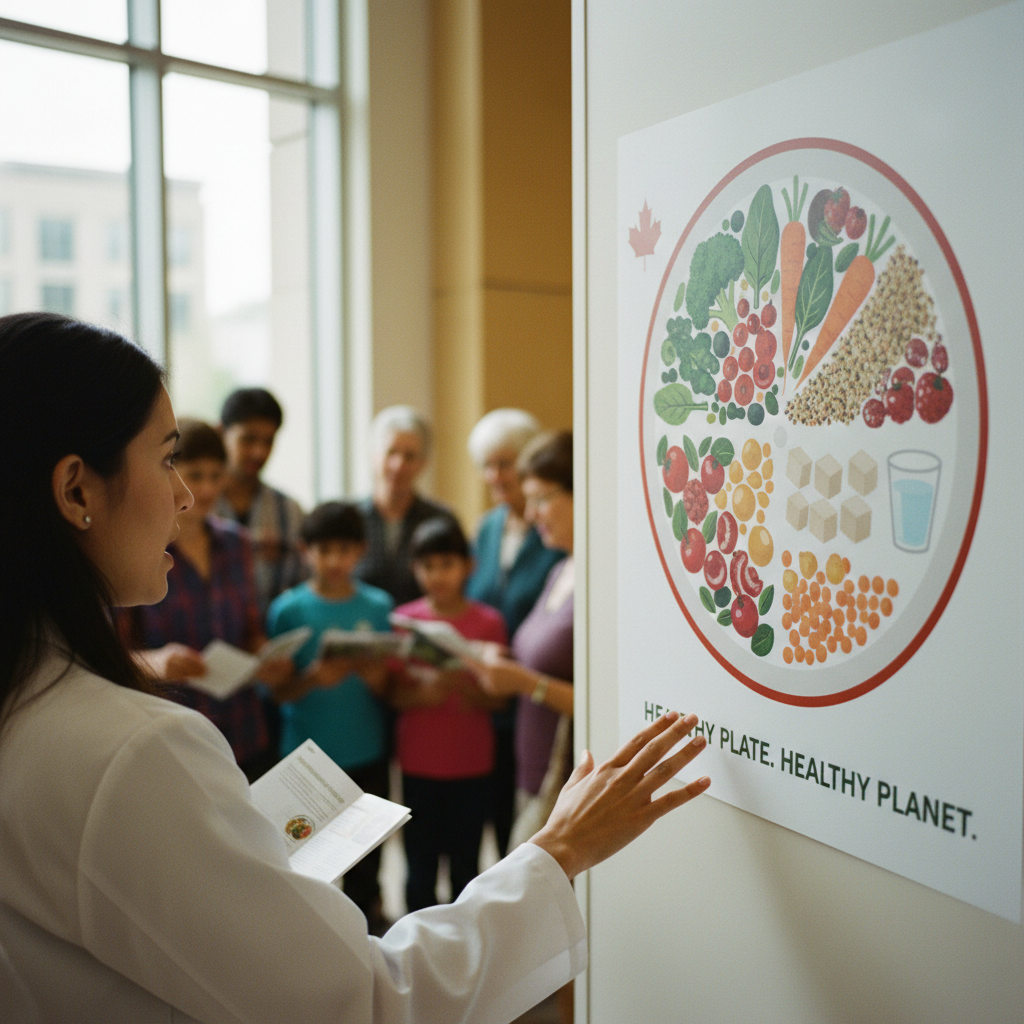
In January 2019, Health Canada released a new food guide that was revolutionary in its simplicity and its courage. It scrapped the old rainbow format with its prescribed number of servings from four food groups. In its place was a simple image of a plate: half-covered with fruits and vegetables, one-quarter with whole grains, and one-quarter with "protein foods."
Critically, the "protein" category deliberately lumped together meat, dairy, and plant-based options like lentils and tofu, and the accompanying text actively encouraged Canadians to "choose protein foods that come from plants more often." The dairy food group was erased entirely, its products demoted to an optional protein choice. It also made water the "drink of choice," a direct challenge to the milk, juice, and soda industries. Just as important was the process: for the first time, Health Canada officials met only with scientists and health experts, explicitly barring industry lobbyists from the development process to shield the guide from commercial influence.
Denmark’s Climate-Based Diet
Denmark took the next logical step. In 2021, and further detailed in 2023, the Danish government released the world's first official dietary guidelines with an explicit focus on climate. While still advising on health, the recommendations are designed to help citizens eat within planetary boundaries.
The advice is strikingly direct: "Eat less meat, especially beef and lamb." The government recommends a maximum of 350 grams (about 12 ounces) of meat per week, a significant reduction from the average Danish intake. The guidelines champion a "plant-rich diet" abundant in legumes, vegetables, and whole grains. This policy represents a paradigm shift, formally connecting the act of eating to its global environmental consequences.
| Country/Region | Old Guideline (Example) | New Guideline (Example) | Key Change Driver |
|---|---|---|---|
| Canada | "Have 2-3 servings of Meat and Alternatives." "Have 2-4 servings of Milk and Alternatives." | "Choose protein foods that come from plants more often." Water is the "drink of choice." | Health evidence; shielding from industry lobby. |
| USA | "Choose lean or low-fat meat and poultry." Recommends 3 cups/day of fat-free/low-fat dairy. | (Largely unchanged) Language slightly shifts to "variety" of protein, including soy, nuts, seeds. Dairy remains key. | Intense industry lobbying; political polarization. |
| Germany | Recommends daily meat, poultry, or fish. | Recommends that 75% of diet be plant-based; limit meat to a maximum of 300g (10.5oz) per week. | Health and environmental science (German Nutrition Society). |
| Denmark | General advice on healthy eating, with meat as a standard component. | "Eat a plant-rich, varied and not too much diet". Explicit weekly limit on meat (350g) for climate reasons. | Climate impact; planetary health goals. |
The Anatomy of Industry Resistance
This progressive shift has not gone unchallenged. The global meat and dairy industries, worth trillions of dollars, have deployed a sophisticated and well-funded playbook to protect their interests. Their tactics, often mirroring those used by the tobacco and fossil fuel industries, focus on a few key strategies:
- Manufacturing Doubt: Funding and promoting industry-led studies designed to produce results that muddy the waters and contradict independent science. These are often published in less-rigorous journals and then amplified through public relations campaigns.
- Lobbying and Political Donations: Pouring millions of dollars into lobbying efforts to gain access to policymakers and influence the language of dietary guidelines. In the U.S., the meat and dairy industries are perennial major political donors.
- Co-opting Health Professionals: Sponsoring nutritional conferences, funding university programs, and providing "educational materials" to dietitians and doctors to ensure their products are presented in a favorable light.
- Attacking the Messengers: Discrediting reputable scientific bodies like the IARC and EAT-Lancet Commission, painting them as biased or driven by an "ideological agenda" against animal agriculture.
In the 2020 U.S. dietary guideline process, a report by the non-profit ProPublica revealed how a congressionally mandated committee was stacked with members who had financial ties to the meat, dairy, and soda industries, leading to recommendations that largely ignored scientific advice to explicitly reduce red meat and sugar-sweetened beverage consumption.
This intense pressure explains why many countries, most notably the United States, have been slow to adapt their guidelines. The 2020-2025 Dietary Guidelines for Americans fell short of recommending a reduction in red meat, despite advice from its own scientific advisory committee, a decision widely seen as a victory for the meat lobby.
A New Lexicon for Food
Beyond the headline-grabbing changes is a subtle but profound shift in the language of nutrition. For decades, "protein" was virtually synonymous with meat. This automatic association was a massive marketing coup for the industry. Now, health authorities are painstakingly working to decouple the two.

New guidelines from Germany, the Netherlands, and others now include specific, separate recommendations for:
- Legumes: Lentils, beans, chickpeas
- Nuts and Seeds
- Meat, Poultry, Fish, and Eggs
By creating distinct categories, they break the monolithic "protein group" and elevate plant sources to an equal, and often preferred, footing. They are re-educating the public that protein is a nutrient found in a wide variety of foods, not a food group defined by animals.
This is a quiet but critical front in the battle for the future of food. Changing the language changes the thinking, which in turn changes the policy and the plate.
Timeline of Key Guideline & Report Publications
| Year | Publication | Significance |
|---|---|---|
| 1992 | USDA Food Guide Pyramid | Established the grain-based pyramid with prominent meat and dairy groups, influencing global guidelines. |
| 2007 | FAO: "Livestock's Long Shadow" report | First major UN report to quantify the huge environmental footprint of animal agriculture. |
| 2015 | WHO/IARC Monograph on Red and Processed Meats | Classified processed meat as a Group 1 carcinogen, creating a direct, high-profile health warning. |
| 2019 | Canada's Food Guide | Radically broke from food groups, eliminated the dairy group, and explicitly promoted plant-based proteins. |
| 2019 | EAT-Lancet Commission: "Food in the Anthropocene" | Outlined the first comprehensive scientific targets for a healthy diet from a sustainable food system. |
| 2021 | Denmark's Climate-Focused Dietary Guidelines | Became the first country to integrate explicit climate goals into its official national nutrition advice. |
| 2024 | Germany's New Nutrition Strategy | Recommended a diet that is at least 75% plant-based and set a low weekly maximum for meat consumption. |

By the numbers
A few statistics help frame the scale of the issue:
- 14.5%: The share of all anthropogenic greenhouse gas emissions that come from the livestock sector. (Food and Agriculture Organization of the UN)
- 77%: The percentage of global agricultural land used for livestock (grazing and growing feed), despite supplying only 18% of the world's calories. (Our World in Data)
- 50 grams: The daily portion of processed meat (equivalent to one hot dog or a few strips of bacon) that increases the risk of colorectal cancer by 18%. (World Health Organization/IARC)
- 90%: The reduction in beef consumption required in Western countries to achieve the EAT-Lancet Commission's "planetary health diet" targets. (EAT-Lancet Commission)
- $50 Million: The amount spent on lobbying by the U.S. meat processing and products industry in 2023 alone. (OpenSecrets)
Frequently Asked Questions
Are plant-based diets deficient in protein?
This is a common myth. A varied, calorie-sufficient plant-based diet provides more than enough protein. Legumes (beans, lentils), soy products (tofu, tempeh), nuts, seeds, and whole grains are all excellent protein sources. The focus on "protein deficiency" is often a marketing tactic, as true deficiency is extremely rare in developed countries.
What about iron and vitamin B12?
Iron is abundant in plant foods like lentils, spinach, and fortified cereals (non-heme iron). Its absorption is enhanced by pairing it with vitamin C-rich foods (like citrus, bell peppers). Vitamin B12 is the one nutrient not reliably found in plant foods, as it's produced by bacteria. Anyone following a strict vegan diet should take a reliable B12 supplement or consume B12-fortified foods.
Aren't plant-based meat alternatives ultra-processed?
Some are, and it's wise to consume them in moderation, just as with their animal-based counterparts like sausages and chicken nuggets. However, the core of a healthy plant-based diet, as recommended by these new guidelines, is centered on whole or minimally processed foods: vegetables, fruits, whole grains, and legumes—not processed substitutes.
Will these new guidelines actually change what people eat?
Policy is a powerful educator. While individual change is slow, dietary guidelines influence public procurement for schools, hospitals, and military bases, shaping millions of meals. They also provide the foundation for nutrition education and food labeling, shifting cultural norms over time.
Is this an "all or nothing" approach? Do I have to go vegan?
Absolutely not. The consistent message across all these new guidelines is not about absolutism but about a shift in balance. The core advice is to eat more plants and less meat, particularly red and processed meat. Even modest shifts in this direction, repeated across a population, yield enormous benefits for public health and the environment.
The Path Forward: From Guideline to Table
The science is clear, and a policy consensus is beginning to form. The question is no longer if our diets need to change, but how we accelerate that change in a way that is equitable, accessible, and just. The evolution of dietary guidelines is a slow, methodical process, but it is moving in a clear direction—away from a plate centered on animal products and toward one that embraces the diversity and resilience of the plant kingdom.
For readers, the implications are both personal and political. You can be part of this shift by aligning your own plate with the emerging scientific consensus. But more powerfully, you can be a voice for policy change. Support organizations that advocate for science-based dietary guidelines. Pay attention to your country's next guideline revision process and demand it be shielded from industry influence. The quiet revolution happening in public health policy needs a loud, public mandate to bring its recommendations from the page to the plates of people everywhere.
Sources
- — Our World in Data (2022)