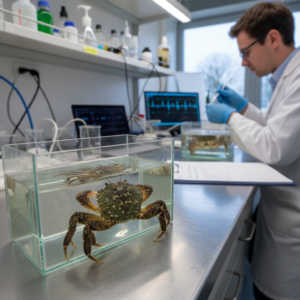

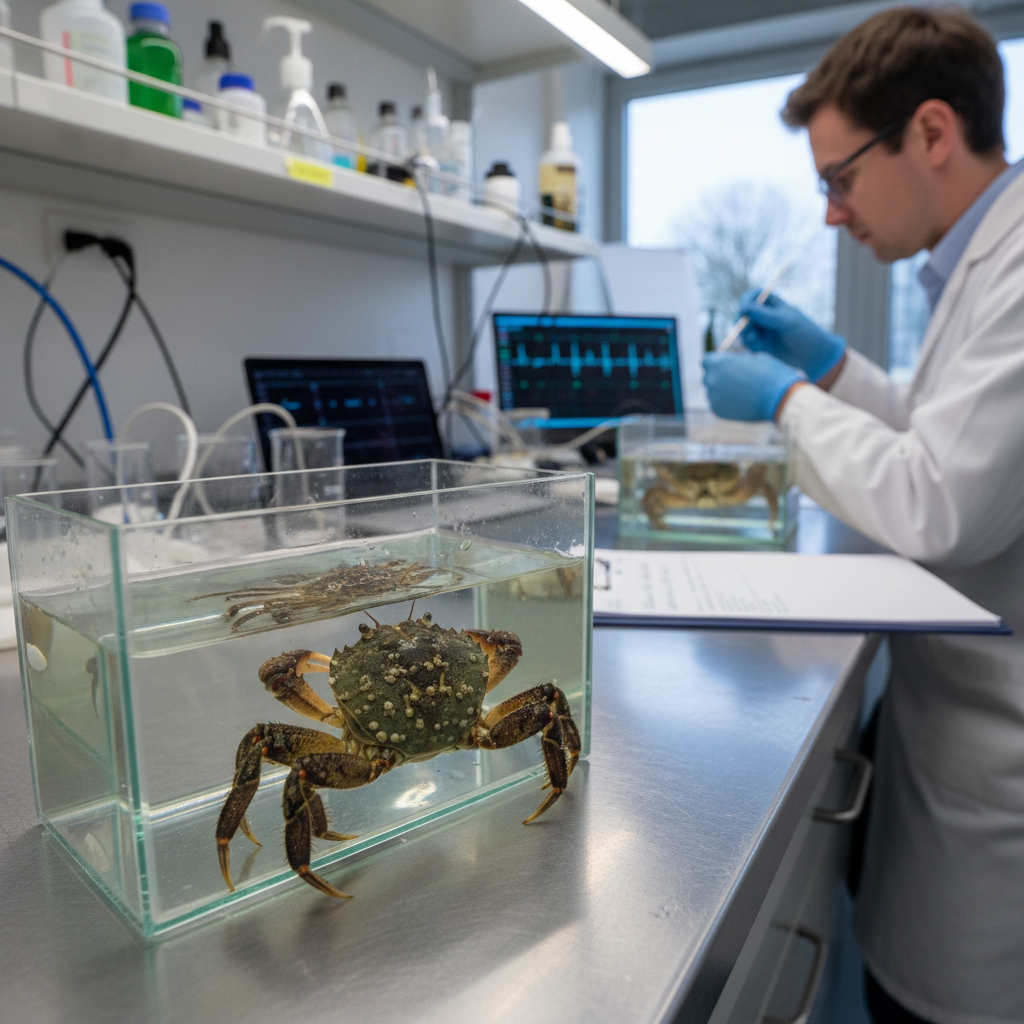
In a quiet laboratory at Queen's University Belfast, a single prawn hangs suspended in a tank. An electrode is positioned to deliver a mild, targeted shock. For decades, the conventional wisdom held that any reaction would be a mere "nociceptive" reflex—an automatic, unconscious twitch away from a noxious stimulus, no more meaningful than a plant turning toward the sun. But what Professor Robert Elwood and his colleagues observed was something far more profound, a deliberate and lasting response that would send shockwaves of its own through the worlds of neuroscience and animal ethics.
Key takeaways
- 🔬 A strong scientific consensus is emerging, supported by over 300 peer-reviewed studies, that decapod crustaceans like crabs, lobsters, and prawns are sentient and capable of feeling pain, not just exhibiting simple reflexes.
- ⚖️ In response to this evidence, nations including the United Kingdom, Switzerland, Norway, Austria, and New Zealand have enacted laws recognizing crustacean sentience, banning inhumane practices like boiling alive without prior stunning.
- 🦀 Controlled experiments demonstrate that crustaceans learn to avoid painful stimuli, make trade-offs between avoiding pain and securing resources, and show physiological stress responses, behaviors inconsistent with the idea of being simple automata.
- 🌍 The global fishing and farming of crustaceans involves hundreds of billions of individual animals each year, representing one of the largest and most overlooked animal welfare crises on the planet.
- ✅ Humane slaughter technologies, such as electrical stunning, have been developed and are commercially available, offering viable alternatives to conventional methods like dismemberment and boiling.
A Shock to the System
For most of human history, the question of whether a lobster feels pain when dropped into a pot of boiling water was dismissed as sentimental anthropomorphism. They were seen as aquatic insects, their nervous systems too primitive, their brains too alien, to support anything resembling subjective experience. The legal and industrial frameworks built around their capture and consumption reflected this assumption. They were, and in most parts of the world remain, treated as insensate objects.
This paradigm began to crack under the weight of meticulous, often elegant, experimental design. Professor Robert Elwood, a leading figure in this field for over two decades, moved beyond simple observation. In one foundational study, he and his team applied a mild electric shock to the abdomen of prawns. The prawns that were shocked exhibited a vigorous and complex tail-flexing response, a clear aversive behavior. But the key finding was what happened next. When a topical anesthetic was applied to the shocked area, the tail-flexing was significantly reduced. If the behavior were a mere reflex, an anesthetic that blocks pain signals should have had no effect. The implication was clear: the response was mediated by a centralized pain system.
Another series of landmark experiments involved common shore crabs. Elwood placed crabs in a brightly lit enclosure with two dark shelters to choose from. After a crab chose a shelter, it was removed, and one of the two shelters was randomly assigned to deliver a mild electric shock. When the crab was returned to the enclosure, it would again seek shelter. After just two trials, most crabs had learned to avoid the shelter where they had been shocked, instead choosing the safe alternative. This demonstrated not only that they found the shock aversive, but that they remembered the location associated with the negative experience and altered their future behavior accordingly. This is a hallmark of pain-based learning, a far cry from a simple, hardwired reflex.
More Than Mere Reflex
Critics long argued that these aversive reactions were no different from a person automatically pulling their hand from a hot stove—an unconscious spinal reflex. But the research has systematically dismantled this argument by demonstrating behaviors that require a centralized, integrated experience of pain. The key distinction lies between nociception—the simple detection of a harmful stimulus—and pain, the subjective, negative emotional experience that accompanies it. The evidence suggests crustaceans bridge that gap.
One of the most powerful lines of evidence comes from studies of "motivational trade-offs." In a 2013 study by Magee and Elwood, hermit crabs were given a mild shock inside their shells. Hermit crabs have a strong motivation to remain protected within a shell. When shocked, however, many crabs chose to abandon their shells, indicating they were trading the security of the shell for the relief from the noxious stimulus. Furthermore, the likelihood of them leaving their shell was dependent on the quality of the shell they inhabited. Crabs in less-desirable shells were much quicker to exit when shocked than crabs in high-quality shells. This is not a simple reflex; it is a complex, context-dependent decision, weighing the severity of the pain against the value of the resource.
"They are not merely responding to injury; they are learning from it, remembering it, and changing their future behavior to avoid it."
To codify the criteria for pain, researchers have developed a framework of indicators. The evidence from crustaceans now satisfies many of them.
| Criteria for Pain Response | Evidence in Decapod Crustaceans |
|---|---|
| Possesses suitable receptors | Nociceptors found across the body that respond to mechanical, thermal, and chemical threats. |
| Possesses integrative brain regions | Complex ganglia and neural structures capable of processing information and forming memories. |
| Pathways are changed by anesthetics | Local anesthetics and analgesics (like morphine) reduce or abolish avoidance behaviors. |
| Learned avoidance | Rapidly learn to avoid locations and contexts associated with painful stimuli. |
| Motivational trade-offs | Willingly give up valuable resources (like a protective shell or a dark shelter) to avoid pain. |
| Grooming and guarding behaviors | Tend to and protect injured body parts, behavior not seen with non-injurious stimuli. |
| Physiological stress responses | Exhibit elevated stress hormones (like crustacean hyperglycemic hormone) in response to injury. |
These findings collectively paint a picture of an animal that is not a machine but a subject, one whose world is shaped by the drive to seek pleasure and avoid suffering.

The Architecture of a Mind
Skeptics often point to the decentralized nervous system of crustaceans as proof of their incapacity for sentience. They lack the large, centralized neocortex that we associate with consciousness in mammals. However, this argument is increasingly seen as a form of "vertebrate chauvinism." Evolution has produced myriad solutions to the problem of information processing. The crustacean nervous system consists of a brain connected to a series of ganglia (nerve clusters) distributed throughout the body. While structurally different, this system is highly complex.
Neuroscientists have found that crustaceans possess sophisticated sensory organs and the neural capacity to process that information in complex ways. They have opioid receptors and respond to analgesics like morphine, suggesting a biochemical system for modulating pain similar to our own. When injured, they will rub, guard, or groom the affected area, a protective behavior that indicates a focused awareness of the injury's location, rather than a generalized, reflexive thrashing.
In late 2021, this body of evidence was systematically evaluated by a team of independent experts commissioned by the UK government. Led by Dr. Jonathan Birch from the London School of Economics and Political Science (LSE), the team reviewed over 300 scientific studies. Their landmark report concluded there was "strong evidence" for sentience in decapod crustaceans (including crabs, lobsters, and prawns) and cephalopod molluscs (like octopus and squid).
"After reviewing over 300 studies, our conclusion was that the evidence of sentience in decapod crustaceans is strong. In our report, we recommended that they be included in the scope of animal welfare law." — Dr. Jonathan Birch, Professor, London School of Economics
This wasn't a marginal finding; it was a rigorous, evidence-based conclusion that has reshaped the legal landscape.
A Turning of the Tide: Legal and Ethical Shifts
The LSE report was a catalyst. In April 2022, the United Kingdom passed the Animal Welfare (Sentience) Act, explicitly including all decapod crustaceans and cephalopod molluscs as sentient beings deserving of legal protection. The law does not ban their fishing or consumption but establishes a formal committee to scrutinize government policy, ensuring that their welfare is considered in future legislation. Crucially, it paved the way for guidance under existing welfare laws that effectively bans the practices of boiling alive and live dismemberment in commercial kitchens without prior, effective stunning.
The UK is not alone. A growing number of jurisdictions have taken similar steps, moving crustaceans from the category of "thing" to that of "sentient animal" in the eyes of the law.
| Country / Region | Legal Protections for Decapod Crustaceans |
|---|---|
| United Kingdom | Formally recognized as sentient (2022). Unlawful to boil alive without stunning in commercial settings. |
| Switzerland | Banned the boiling of live lobsters without stunning (2018). Requires they be kept in natural water conditions during transport. |
| Norway | Animal Welfare Act (2009) includes crustaceans, requiring humane slaughter and consideration of their welfare. |
| New Zealand | Animal Welfare Act (1999) code requires that crustaceans for consumption must be killed humanely. Boiling alive without stunning is illegal. |
| Austria | Animal Welfare Act explicitly prohibits the boiling or dismembering of live crustaceans. |
| USA & Canada | No federal laws protecting crustaceans. They are explicitly excluded from the methods of humane slaughter acts. |
This legal shift reflects a moral one. As the scientific evidence becomes more mainstream, the cultural license to inflict suffering on these animals is being revoked. The image of a lobster thrashing in a pot of boiling water is slowly changing from a culinary tradition to an act of indefensible cruelty.
| Shrimps & Prawns | 11.7 Million Tonnes | |
|---|---|---|
| Crabs | 3.1 Million Tonnes | |
| Lobsters | 0.3 Million Tonnes | |
| Other | 0.8 Million Tonnes |
By the Numbers
The scale of crustacean use is staggering, making their welfare a globally significant issue.
- 400 Billion+: The estimated number of individual crustaceans (shrimps, prawns, crabs, lobsters) farmed or caught globally each year, though the true number is likely higher due to a lack of systematic counting. (Faunalytics, 2019)
- 300: The number of peer-reviewed scientific studies analyzed by the London School of Economics in their report concluding that crustaceans are sentient. (LSE, 2021)
- 7 minutes: The maximum time a crab can continue to show signs of physiological stress and neural activity after its shell and gills are ripped off during live dismemberment. (Scientific Reports, 2015)
- 15.9 million tonnes: The total weight of crustaceans caught or farmed globally for food in 2022, a figure that has more than tripled since 1990. (FAO, 2024)
- 8: The number of criteria for sentience (out of a possible 10) for which the LSE report found strong evidence in crabs.
- 0: The number of federal laws in the United States that provide any welfare protection to the billions of crustaceans processed in the food system each year. (U.S. Animal Welfare Act)
The Weight of Water: Industry and a Culture of Cruelty
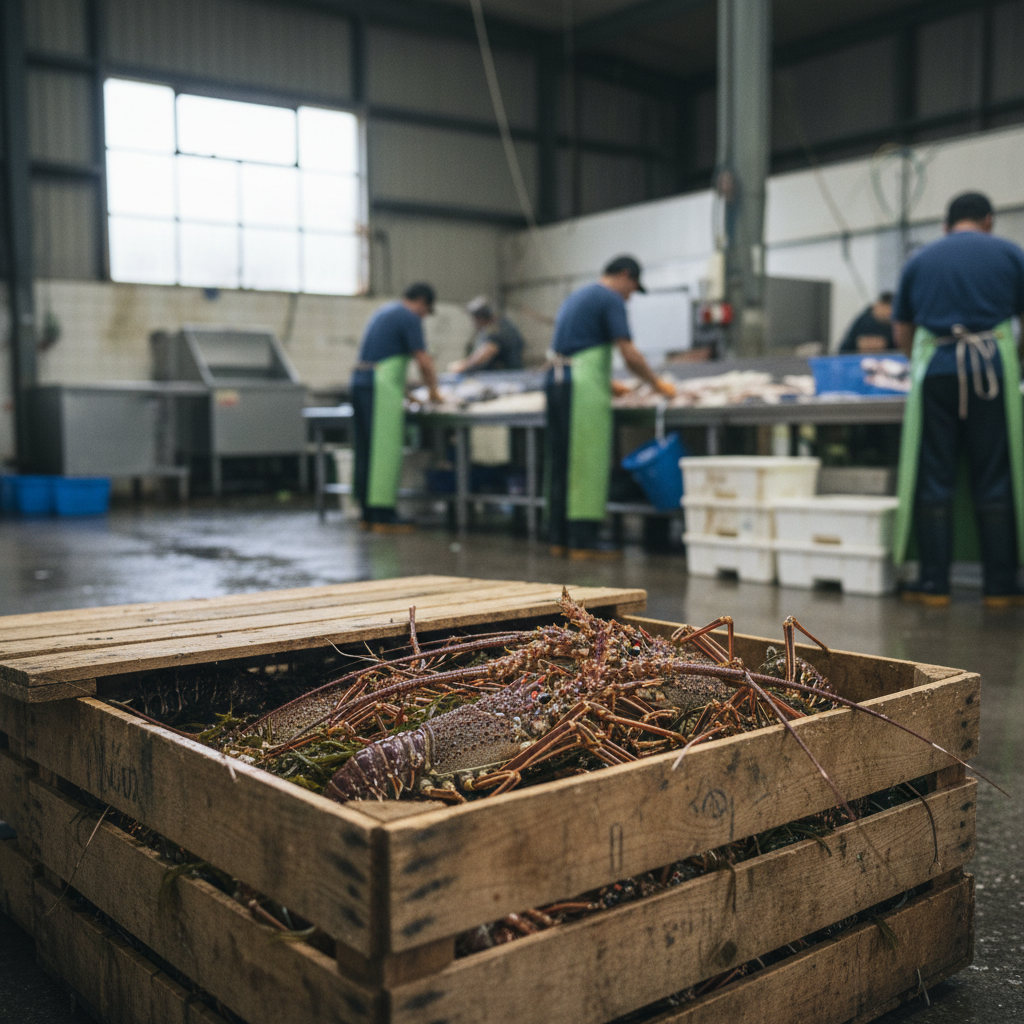
Despite the scientific and legal progress, the lived reality for the vast majority of crabs and lobsters remains brutal. Standard industry practice involves numerous stages of acute stress and suffering.
- Capture: Wild-caught crustaceans often suffer injuries in nets or traps, where they can be confined for days without food.
- Handling & Transport: They are handled roughly and packed tightly into crates, often for long-distance air freight, where they can be out of water for extended periods. Their claws are often bound or pegged, which can cause injury and stress.
- Storage: In wholesalers and restaurants, they are typically kept in brightly lit, overcrowded tanks with poor water quality, sometimes after weeks or months in deprived storage conditions. These are stressful, unnatural environments.
- Slaughter: The most common end-of-life treatment is boiling alive. Other methods include dismemberment (e.g., "tailing" lobsters or tearing the carapace off crabs) while the animal is still fully conscious and alive.
These practices persist not because of a lack of alternatives, but because of inertia and a lack of regulation. For an animal now understood to be capable of feeling pain, this constitutes cruelty on an industrial scale.

Charting a More Humane Course
The most urgent priority is the global adoption of humane slaughter methods. Several effective techniques exist that render the animal insensible before death.
- Electrical Stunning: Devices like the "Crustastun" deliver a powerful electric current that destroys the animal's central nervous system in less than a second, causing immediate and irreversible unconsciousness. This is widely considered the most humane and effective method available today.
- Mechanical Killing: A two-step process of splitting the animal rapidly along its longitudinal midline with a large, sharp knife can destroy the central ganglia quickly. However, this method is highly dependent on operator skill and speed to be considered humane.
- Chilling: Placing crustaceans in an ice slurry or a freezer is sometimes promoted as a humane method. However, research suggests that this process can be slow and stressful, and may not fully numb the animals before they are killed. It is generally considered less reliable than electrical stunning.

For consumers, the shift begins with awareness. Supporting restaurants and suppliers that have adopted humane practices is a powerful market signal. In jurisdictions where regulations are lax, advocating for legal protections similar to those in the UK and Switzerland is a crucial step. The science has provided the "what"; the public and policymakers must now decide "what next."
Frequently Asked Questions
But they don't have a brain like ours, so how can they feel pain?
This is a common misconception. While their brains are structurally very different from ours, they have complex nervous systems and ganglia that perform similar functions, including learning, memory, and processing noxious stimuli. The scientific evidence shows they display the key behaviors associated with pain, indicating that a vertebrate-style brain is not a prerequisite for subjective experience.
Is there a humane way to kill a crab or lobster at home?
Boiling alive is now widely considered inhumane. The most reliable method is mechanical destruction. For a lobster or crab, this involves placing it on a board and using a large, sharp chef's knife to swiftly cut down through the center of its head/thorax, destroying the main nerve centers. This should be done in less than a second. Electrical stunning devices are the gold standard but are typically only available for commercial use.
Are smaller crustaceans like shrimp and krill also sentient?
Shrimp and prawns are decapod crustaceans, just like crabs and lobsters, and the LSE review concluded there is "strong evidence" for their sentience. The evidence for other, smaller crustaceans like krill is less studied and therefore less certain, but given the biological similarities, many scientists argue for a precautionary approach.
What legal protections exist for crustaceans in the United States?
Currently, there are virtually no federal or state-level animal welfare laws in the U.S. that protect crustaceans. The Animal Welfare Act and Humane Methods of Slaughter Act both explicitly exclude invertebrates, meaning they can be legally treated in ways that would be felony cruelty if applied to a vertebrate animal.
Why has this become a major topic of discussion only recently?
The shift is due to a critical mass of scientific evidence being published over the last two decades. While individual studies existed before, the sheer volume and consistency of the recent findings, culminating in comprehensive reviews like the 2021 LSE report, have made the case for sentience undeniable to many scientists and policymakers.
A Final Call to Consciousness
The story of crustacean sentience is not just about crabs and lobsters; it's about our own capacity for moral expansion. It challenges us to look beyond familiar forms of intelligence and consciousness and to confront uncomfortable truths about our food systems. The science is no longer in serious doubt. The question facing us now is a test of our own compassion: Will we adjust our ethics and our laws to reflect what we have learned, or will we continue to dismiss the suffering of a creature simply because it does not scream in a way we can recognize? The next time you see a lobster in a tank, you may find yourself asking not "Can it feel?" but "What are we going to do about it?" For more information on humane practices and advocacy, consider the resources provided by the Humane Society of the United States and Crustacean Compassion.
Sources
- — Food and Agriculture Organization of the United Nations (FAO) (2024)
- — UK Government (2022)