
'''
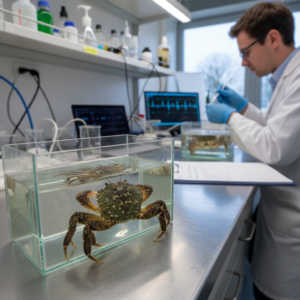
In the cool, filtered light of a laboratory tank, a common octopus (Octopus vulgaris) methodically inspects a transparent acrylic box, a single juicy shrimp visible within. There’s a catch: a three-step locking mechanism. To the astonishment of its observers, the octopus doesn’t just flail; it pauses, probes, and within an hour, deliberately pushes a latch, pulls a bolt, and turns a screw-like lid to claim its prize. This isn’t a trained circus act; it’s a demonstration of a mind at work, a mind belonging to an animal we are harvesting from our oceans by the millions of tonnes each year, with almost no consideration for its inner life.
Key takeaways
- 🔬 Sentience Confirmed: A robust and growing body of scientific evidence suggests that cephalopods—octopuses, squid, and cuttlefish—are sentient, capable of experiencing feelings like pain, distress, and even pleasure. This challenges our traditional, vertebrate-centric view of consciousness.
- ⚖️ A Global Policy Void: Despite their recognized intelligence, cephalopods exist in a legal and ethical blind spot. There are currently no international laws and very few national regulations protecting their welfare during commercial capture, handling, and slaughter.
- 📉 Escalating Harvest: As global stocks of finfish decline, fishing fleets are increasingly targeting cephalopods. Global catches have more than tripled in the last fifty years, placing immense and unsustainable pressure on their populations worldwide.
- 🧠 An Alien Intelligence: The unique, distributed nervous system of cephalopods, with two-thirds of their neurons located in their arms, represents a second, independent evolution of high intelligence on Earth. Understanding it forces us to reconsider our own definitions of cognition.
- ✅ A Path Forward: Groundbreaking legal changes, such as the United Kingdom’s 2022 decision to include cephalopods under its Animal Welfare (Sentience) Act, provide a crucial precedent and a potential roadmap for improving welfare standards across the globe.
A Mind in Every Arm
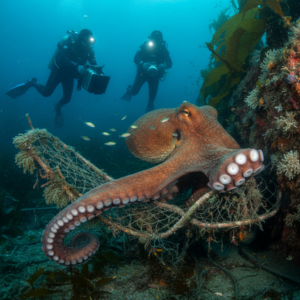
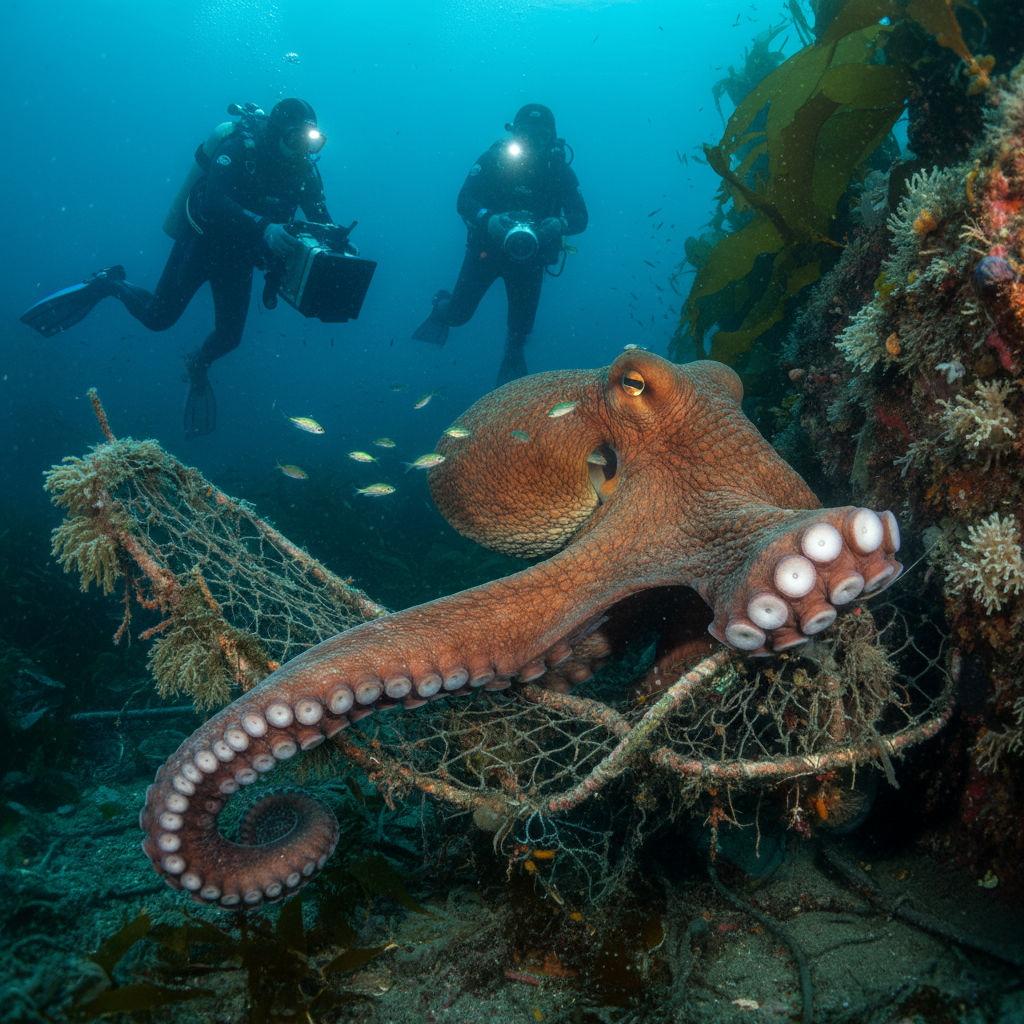
To understand a cephalopod is to let go of our vertebrate-centric biases. Theirs is a story of intelligence evolving on a completely different branch of the tree of life. While our last common ancestor was likely a simple worm-like creature over 600 million years ago, the path cephalopods took led to a neurological architecture startlingly alien and profoundly complex. An octopus possesses about 500 million neurons—a number comparable to a small dog—but more than two-thirds of these are not in its central brain. Instead, they are distributed throughout its eight arms.
Each arm can, to a degree, think for itself. It can taste, touch, and operate with a startling level of autonomy, solving minor problems without direct input from the central brain. This "distributed intelligence" allows for incredible feats of multitasking and environmental interaction. While the central brain acts as an executive, setting goals and giving high-level commands, the arms figure out the specifics. It is, as some neuroscientists have described it, like having eight independent, problem-solving appendages tethered to a central processor. This evolutionary strategy is utterly different from our own, where a single, hyper-centralized brain exerts precise top-down control.
This unique biology supports a suite of behaviors that are undeniably "intelligent" in any meaningful sense of the word. They are masters of camouflage, capable of changing their skin’s color, pattern, and texture in milliseconds to match their surroundings or communicate with other cephalopods. This isn’t a simple reflex; studies on cuttlefish have shown they adjust their camouflage based on visual feedback, even accounting for the perceptual abilities of their potential predators.
The Weight of Evidence: From Anecdote to Axiom
For centuries, tales from sailors and divers of octopus ingenuity were dismissed as folklore. Today, rigorous scientific inquiry has replaced anecdote with a mountain of evidence. Controlled laboratory experiments and careful field observations have built an undeniable case for their advanced cognition.
One of the most famous examples of their problem-solving ability comes from numerous studies showing they can learn to open screw-top jars to get food, a task that requires both dexterity and an understanding of cause and effect. They have demonstrated the capacity for observational learning—watching another octopus solve a puzzle and then solving it themselves, often more quickly.
Beyond simple problem-solving, their behavior points to a more complex inner world:
- Tool Use: In a landmark 2009 observation, veined octopuses in Indonesia were seen gathering discarded coconut shell halves, carrying them across the seafloor, and assembling them as a portable shelter. This act of foresight—transporting an object for future use—is considered a key indicator of complex cognition.
- Play: Octopuses in aquarium settings have been observed engaging in behavior that can only be described as play. They have been seen repeatedly releasing objects into a water current and catching them again, an activity with no apparent survival benefit, much like a human child throwing a ball.
- Personality: Researchers who work closely with cephalopods consistently report distinct and stable personalities. Some individuals are bold and exploratory, others are shy and reserved, while some are even described as mischievous, known for squirting water at specific researchers they seem to dislike.
This accumulation of evidence led to a pivotal moment in 2012, when a prominent international group of neuroscientists, cognitive ethologists, and philosophers of mind gathered at the University of Cambridge to sign the Cambridge Declaration on Consciousness. After reviewing the neurological evidence for a wide range of animals, they declared that "the weight of evidence indicates that humans are not unique in possessing the neurological substrates that generate consciousness." Crucially, they noted that these substrates are present in "non-human animals including all mammals and birds, and many other creatures, including octopuses."

Pain, Distress, and the Sentient Sea
Intelligence is one thing; sentience, the capacity to have feelings and subjective experiences, is another. While related, it is sentience that forms the bedrock of ethical concern. An animal that can feel pain, fear, or distress has a welfare that can be harmed. A growing consensus of research, powerfully summarized in a 2021 London School of Economics report, concludes that cephalopods are indeed sentient.
A groundbreaking 2021 study led by neurobiologist Robyn J. Crook provided some of the most direct evidence to date. The study demonstrated not just that octopuses can learn to avoid a location where they were previously exposed to a painful stimulus (a standard test for pain perception), but that they display behaviors indicative of a negative affective, or emotional, state. After a single injection of acetic acid into an arm, the octopuses showed a clear and lasting preference for a chamber where they could self-administer a local anesthetic. They were not just reacting to a noxious stimulus; they appeared to be seeking relief from an ongoing, unpleasant internal experience. This is a critical distinction, separating a simple reflex from the complex experience of suffering.
"If we can make contact with cephalopods as sentient beings, it's not because of a shared history, not because of kinship, but because evolution built minds twice over." — Peter Godfrey-Smith, philosopher and author of Other Minds: The Octopus, the Sea, and the Deep Origins of Consciousness
This confirmation of sentience casts a harsh light on the methods used in global fisheries. Cephalopods are typically caught using trawl nets, jigs, or pots. Trawling involves dragging enormous nets across the ocean floor, causing immense stress and physical injury. Jigging involves luring squid and cuttlefish with bright lights and capturing them on sharp, barbed hooks. Once on deck, there are no standardized, humane slaughter methods. They are often left to asphyxiate in the air, frozen alive in ice slurries, or killed by crude methods like clubbing or brain spiking, which are often inaccurately performed on a moving vessel. Each of these common industry practices is now understood to cause prolonged and severe suffering in a sentient animal.

The Unseen Harvest: A Global Boom in Cephalopod Fishing
While the ethical debate gains traction in scientific circles, the economic engine of cephalopod fishing is accelerating. As traditional finfish stocks like cod and tuna face collapse from overfishing, global fishing fleets have pivoted to what was once a secondary catch. The result has been a dramatic and sustained increase in the number of cephalopods being pulled from the sea.
According to data from the UN’s Food and Agriculture Organization (FAO), the global catch of octopuses, squid, and cuttlefish has skyrocketed in recent decades. The numbers paint a stark picture of a rapidly intensifying industry operating on a massive scale.
| 1980 | 1.5 Million tonnes | |
|---|---|---|
| 1990 | 2.7 Million tonnes | |
| 2000 | 3.6 Million tonnes | |
| 2010 | 4 Million tonnes | |
| 2020 | 4.9 Million tonnes |
This boom is driven by soaring market demand, particularly in Asia and Southern Europe, and enabled by sophisticated fishing technologies. Massive factory vessels now use high-intensity light arrays to attract squid from the deep ocean at night, a practice visible from space. The sheer scale is difficult to comprehend, as catches are measured in tonnes, not individual animals. Faunalytics, an animal advocacy research group, estimates that hundreds of billions of individual aquatic animals are killed annually, with cephalopods representing a significant and growing portion of this uncounted toll.
This escalating pressure is not only an ethical crisis but a potential ecological one. Cephalopods are a vital link in the marine food web, serving as both predator and prey for a vast range of species, from whales and dolphins to seabirds and large fish. Their short lifespans and rapid growth rates make their populations prone to dramatic fluctuations, and the long-term impacts of such an intense, targeted fishery are still poorly understood.
| Capture Method | Primary Target Species | Common Welfare Harms |
|---|---|---|
| Bottom Trawling | Squid, Octopus, Cuttlefish | Crushing, barotrauma (pressure injury), extreme stress, abrasion, bycatch mortality. |
| Jigging | Squid | Impalement on barbed hooks, exhaustion, stress from intense lights, slow death on deck. |
| Potting/Trapping | Octopus | Confinement stress, starvation (if traps are left too long), damage from handling, aggression from other trapped animals. |
| Blast Fishing | N/A (Illegal/Destructive) | Massive internal organ damage, painful death, widespread ecosystem destruction. Usually Fatal. |
A Tale of Two Policies: The UK's Precedent and the Global Void
Against this backdrop of mounting evidence and escalating exploitation, a landmark legislative development in the United Kingdom offers a glimmer of hope. In 2022, following a comprehensive review of over 300 scientific studies, the UK government amended its Animal Welfare (Sentience) Bill to formally recognize decapod crustaceans (like crabs and lobsters) and cephalopod molluscs as sentient beings. The review, led by the London School of Economics, concluded there was "strong scientific evidence" for their capacity to experience pain and distress.
This legal recognition does not, in itself, ban the fishing or consumption of these animals. However, it mandates that their welfare must be considered in future government policymaking. This creates a legal foundation for developing new regulations on humane handling and slaughter, such as requiring stunning before killing and banning methods like boiling alive without pre-stunning. It establishes an official "Animal Sentience Committee" to scrutinize the government’s record on animal welfare, and cephalopods are now part of its remit.
The UK’s move has created a stark contrast with the rest of the world, where cephalopods remain almost entirely unprotected.
| Jurisdiction | Research Animals | Farmed Animals | Wild-Caught Animals |
|---|---|---|---|
| European Union | ✅ Protected | ❌ Mostly Unprotected | ❌ Unprotected |
| United States | ✅ (Limited) | ❌ Unprotected | ❌ Unprotected |
| United Kingdom | ✅ Protected | ✅ (Sentience Recognized) | ✅ (Sentience Recognized) |
| Australia/NZ | ✅ Protected | ❌ Mostly Unprotected | ❌ Unprotected |
| Global Average | Partial Protection | No Protection | No Protection |
As the table shows, even in regions where cephalopods are protected in laboratory settings—an acknowledgment of their complexity and capacity for suffering—these protections vanish the moment the animal is classified as "food." This legal and ethical inconsistency is becoming increasingly difficult to defend.

By the Numbers
The scale of our interaction with cephalopods is staggering, yet often hidden within bulk statistics. Here are a few key figures that highlight the urgency of the issue:
- 500,000,000: The approximate number of neurons in a common octopus, comparable to that of a dog. (Various neuroscience sources)
- 4,900,000 tonnes: The total global catch of cephalopods reported in 2020, up from 1.5 million tonnes in 1980. (FAO)
- 300+: The number of scientific studies analyzed by the London School of Economics in its report recommending the UK government recognize cephalopod sentience. (LSE)
- 2/3: The fraction of an octopus's neurons located in its arms, not its central brain, creating a distributed "mind." (Philosophical Transactions of the Royal Society B)
- 0: The number of international laws or treaties specifically protecting the welfare of cephalopods in commercial fishing. (Review of international maritime and animal welfare law)
Frequently Asked Questions
If they're so smart, why do they get caught?
Intelligence is not a shield against all threats. Cephalopods evolved to handle specific challenges like predation and foraging in a complex marine environment. They did not evolve to counter the supernormal stimuli of high-intensity jigging lights or the overwhelming force of a bottom-trawling net that is kilometers wide. Their intelligence is simply mismatched for the industrial-scale technologies we deploy.
Does this mean we should stop eating octopus and squid?
That is the central ethical question, and one that individuals and societies must now confront. Recognizing sentience doesn’t automatically dictate a specific dietary choice, but it does demand that we can no longer treat these animals as mere resources. At a minimum, it obligates us to dramatically reform fishing practices to minimize suffering. For many, a consistent ethical position may indeed lead to choosing plant-based alternatives.
What would humane slaughter for a cephalopod look like?
Humane slaughter methods aim to cause instant or near-instant unconsciousness before death. For cephalopods, this is an area of active research. Potential methods could include electrical stunning or rapid, percussive destruction of the central brain ganglia. The current common practices of asphyxiation, freezing, or clubbing are widely considered inhumane by welfare scientists.
Are farmed octopuses a better alternative?
Octopus farming is an emerging industry, but it is fraught with severe ethical and environmental problems. Octopuses are solitary and carnivorous, meaning they would need to be housed individually to prevent cannibalism and fed on fish meal, which would put further strain on wild fish stocks. Many welfare experts believe the behavioral and psychological needs of such intelligent animals could never be met in a captive farm environment, making farming a potential welfare catastrophe.

Charting a More Humane Course
We stand at a pivotal moment. Science has pulled back the curtain on a form of consciousness that is both profoundly alien and startlingly familiar. The minds in the deep are looking back at us, and we are now faced with a choice. Do we continue to harvest this intelligence with brute indifference, or do we allow our ethics to catch up with our knowledge?
Ignoring the evidence of sentience is no longer a tenable position. The path forward requires a multi-pronged approach rooted in this new understanding. Researchers must work to develop and validate humane methods of capture and slaughter. Policymakers must follow the UK’s lead, creating legal frameworks that recognize cephalopod sentience and mandate that their welfare be taken seriously. Consumers, armed with this knowledge, can drive change by demanding more transparent and humane supply chains or by exploring the wealth of plant-based culinary options.
It is a daunting task, but not an impossible one. We once held similar debates about the welfare of mammals and birds, debates that led to significant, if incomplete, reforms. Now, the ethical frontier has moved into the ocean. It is time to extend our circle of compassion to include these remarkable, intelligent, and sentient minds of the deep.
'''
Sources
- — Our World in Data (using FAO data) (2021)