
The water in the bay shimmered, but not with the silver of darting fish. It was a thick, emerald-green soup, choked with an algal bloom so vast it could be seen from space. This isn't a scene from a dystopian novel; it is the recurring reality in the Gulf of Mexico, in China’s Lake Taihu, and in countless other waterways around the globe. For decades, we have pointed the finger at fertilizer runoff from crop fields, and not without reason. But this is only half the story. A more concentrated, more potent, and more overlooked culprit lies upstream: the mountains of waste generated by industrial animal agriculture, a system that has broken a fundamental cycle of an element we cannot live without—phosphorus.
What is Phosphorus and Why Does It Matter?
Phosphorus is life’s bottleneck. It is a non-negotiable, non-substitutable ingredient for all known life forms. This chemical element forms the backbone of our very DNA and RNA. It is the "P" in ATP (adenosine triphosphate), the molecule that stores and transfers energy in every living cell, from the smallest bacterium to the largest blue whale. Without phosphorus, plants cannot grow, and animals cannot live.
For most of human history, phosphorus, like nitrogen and carbon, operated in a closed loop. Farmers grew crops, which were eaten by people and livestock. The waste from both was returned to the soil, replenishing the phosphorus that had been borrowed. It was a model of perfect recycling, dictated by necessity. But the industrial revolution and the subsequent green revolution of the 20th century shattered this elegant cycle. We discovered how to mine ancient marine deposits of phosphate rock, pulverize it, and apply it to fields in enormous quantities, enabling an explosion in crop yields.
This created a paradox. On one hand, we had a seemingly magic bullet for food production. On the other, we yoked our ability to feed ourselves to a finite, non-renewable resource. Unlike nitrogen, which makes up 78% of our atmosphere and can be synthesized through the Haber-Bosch process, phosphorus cannot be created. What we have is all there is. The world’s high-grade, easily accessible phosphate rock reserves are concentrated in just a few countries—Morocco holds the vast majority, followed by China, Algeria, and the United States. Geopolitical analysts now speak of "peak phosphorus," a concept mirroring "peak oil," which posits a future point in time when we reach maximum production, after which it will become scarcer, more expensive, and a potential source of international conflict.
The Great Imbalance: How Factory Farming Broke the Cycle
The traditional farm was a model of nutrient integration. The modern Concentrated Animal Feeding Operation (CAFO), or factory farm, is a model of nutrient dislocation. The fundamental problem is one of geography. In the United States, for example, the great majority of corn and soybeans are grown in the Midwest—the "Corn Belt." These crops are grown using phosphorus-based fertilizers, often mined in Florida or Idaho, to ensure high yields.
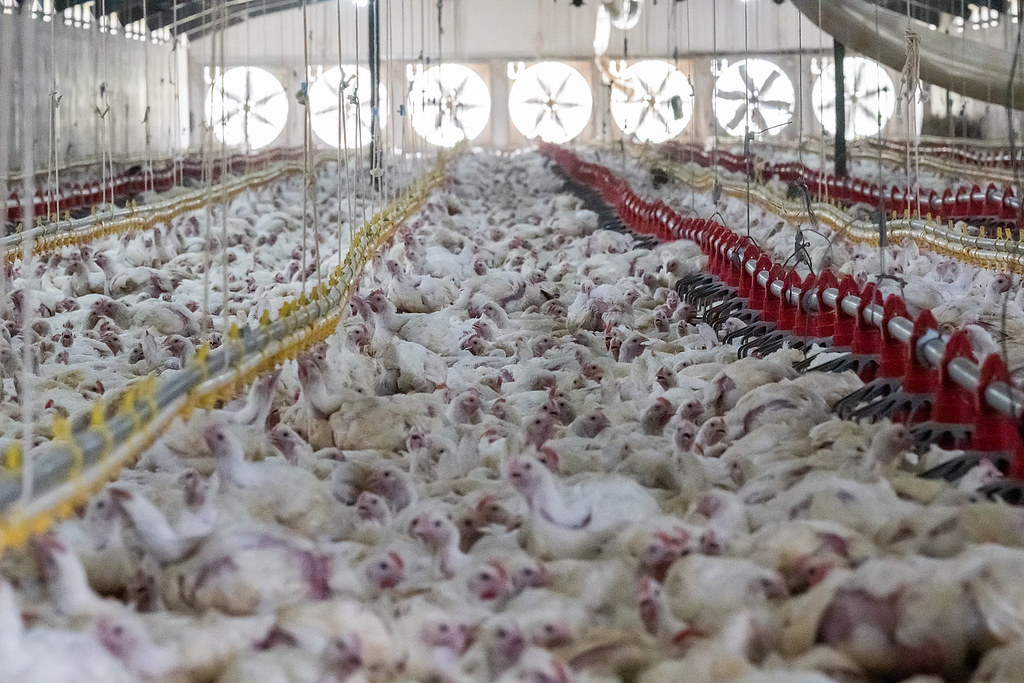
A vast portion of this harvest is not for human consumption. It is trucked, barged, and railed hundreds of miles to centers of industrial animal production: the hog CAFOs of North Carolina, the broiler chicken sheds of the Delmarva Peninsula, the cattle feedlots of Texas and Kansas. Here, thousands, or even millions, of animals are confined in small spaces, where they consume this phosphorus-rich feed.
Animals, however, are not particularly efficient at converting the phosphorus in their feed into bone and muscle. A dairy cow, for instance, excretes around 70% of the phosphorus it consumes. For pigs and chickens, this figure can be even higher. The result is a staggering concentration of phosphorus in one, small geographic area, far removed from the fields where the nutrients were originally applied. The elegant, closed loop of the past has been replaced by a one-way, linear flow: from mine, to Midwestern field, to animal feed, to a colossal lagoon of manure.

From Manure Lagoons to Dead Zones
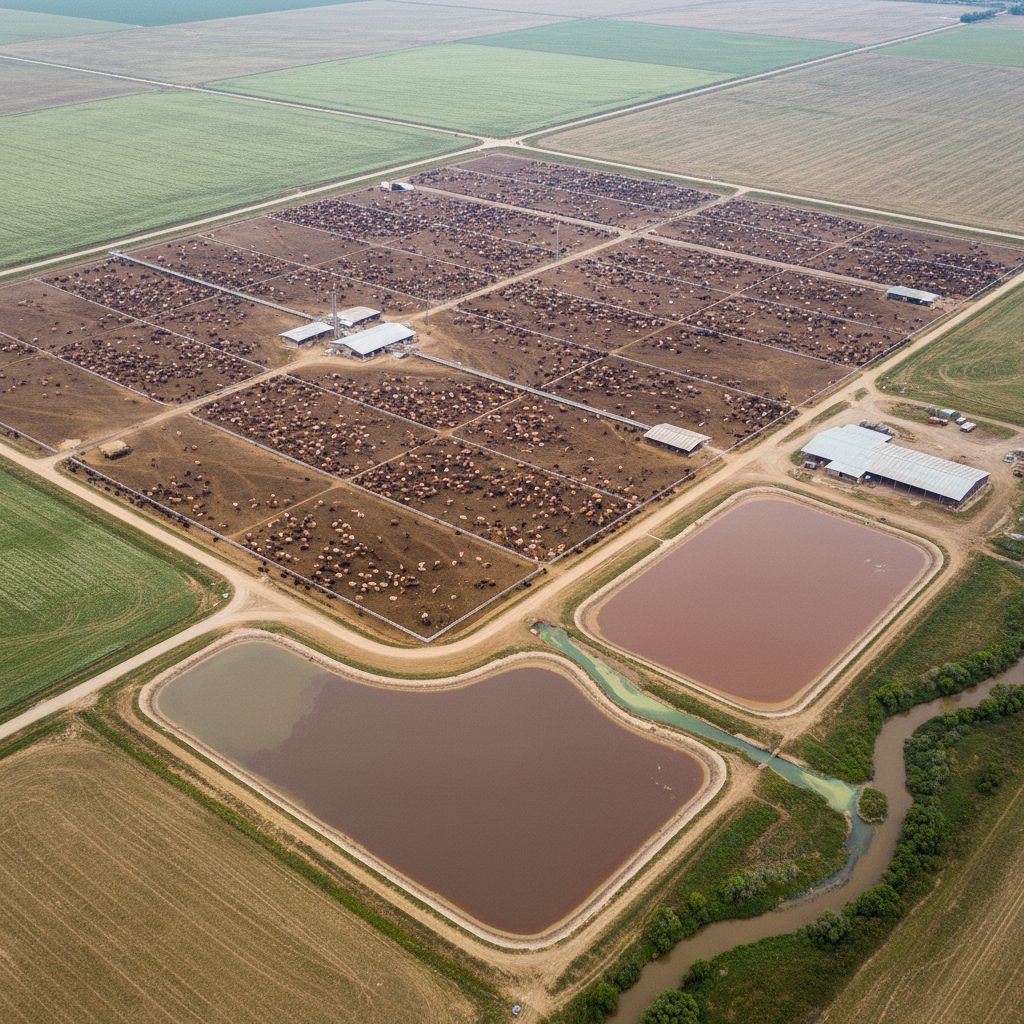
What happens to this super-concentrated animal waste? It is typically stored in vast, open-air pits euphemistically called "lagoons"—often unlined, and containing millions of gallons of toxic slurry. While some of this manure is sprayed on adjacent fields as "fertilizer," the sheer volume produced in these factory-farming hotspots far exceeds what the land can possibly absorb. The soil becomes saturated with phosphorus.
The rest is a story of simple chemistry and gravity. Rainwater and runoff wash this excess phosphorus from the saturated fields and from leaking lagoons into local ditches and streams. These streams flow into rivers, and the rivers flow to the sea. The Mississippi River, for example, acts as a drainage funnel for the agricultural heartland of the United States, collecting the nutrient pollution from dozens of states and flushing it into the Gulf of Mexico.
This sudden injection of a limiting nutrient triggers an ecological cataclysm. The phosphorus that was life’s bottleneck becomes an all-you-can-eat buffet for algae. These microorganisms bloom in astronomical numbers, turning the water into the thick, green soup described earlier. The problem isn’t the bloom itself, but what happens when the algae inevitably die. They sink to the bottom, where they are decomposed by bacteria in a process that consumes massive amounts of dissolved oxygen. The water becomes hypoxic (low in oxygen) or anoxic (devoid of oxygen) altogether. This is what scientists call eutrophication, and it creates a "dead zone." Fish, crabs, shrimp, and any other marine animal that cannot flee this suffocating water simply dies. The Gulf of Mexico dead zone is one of the largest in the world, measuring over 6,300 square miles in 2021—an area larger than the state of Connecticut—all from pollution that began hundreds of miles upstream.
Data Spotlight: The Footprint of Our Food
The numbers paint a stark picture of the inefficiency of cycling nutrients through animals in an industrial system. When we compare the amount of nutrient pollution generated per gram of protein, the disparity between plant-based and animal-based foods is staggering. This data, compiled from a landmark 2018 study in Science, quantifies the eutrophying emissions—the combined impact of phosphorus and nitrogen pollution—of various food products.
| Beef (Beef Herd) | 365.8 g PO₄eq | |
|---|---|---|
| Lamb & Mutton | 118.1 g PO₄eq | |
| Pork | 67.2 g PO₄eq | |
| Poultry Meat | 49.9 g PO₄eq | |
| Tofu (Soybeans) | 14.8 g PO₄eq | |
| Peas | 3.5 g PO₄eq |
This isn't a matter of minor differences; it’s a matter of orders of magnitude. Producing a gram of beef protein generates more than 100 times the water-polluting emissions as producing a gram of protein from peas. The table below illustrates the land and resource dislocation in a different way, comparing a traditional integrated farm with a modern industrial model.
| Feature | Integrated Mixed Farming (Traditional) | Concentrated Animal Feeding Operation (Modern) |
|---|---|---|
| Feed Source | Grown on-site or locally | Shipped from distant agricultural regions |
| Nutrient Flow | Closed Loop (Manure returns to fields) | Linear (Mine -> Field -> Feed -> CAFO -> Pollution) |
| Waste Management | Compost, direct soil application | Over-application, lagoons, runoff, discharge |
| Geographic Scale | Local, self-contained | National or global supply chains |
| Phosphorus Fate | Recycled in soil | Concentrated & exported as water pollution |
A Finite Resource We Can't Afford to Waste
This deluge of pollution represents not just an environmental crisis, but a profound economic and resource security failure. Every gram of phosphorus that contributes to an algal bloom in the Gulf is a gram that has been permanently lost from the agricultural land it came from. It is also a gram that was mined from a finite reserve, at great expense.

As Dana Cordell, a leading phosphorus researcher at the University of Technology Sydney, has pointed out for years, we treat this precious resource with astonishing carelessness.
"We have moved from a situation of phosphorus scarcity in agriculture to one of excess, with major environmental consequences. Recapturing it from waste streams is no longer optional—it is essential for long-term food security."
We are simultaneously depleting our strategic reserves of a non-renewable resource while using the waste product to destroy our aquatic ecosystems. It is a system that is failing on both ends. This is not sustainable—not by any definition.
Charting a Path Forward: Solutions for a Phosphorus-Prudent Future
This crisis, though daunting, is not insurmountable. The hopeful truth is that because the problem is systemic, solutions can be systemic, too. Addressing the phosphorus paradox requires a multi-pronged approach, moving beyond a linear model to a circular one.
Here are some of the key pathways forward:
-
Fundamental Dietary Shifts: The single most impactful lever is also the one most directly in our control. As the data shows, shifting our diets toward plant-centric sources of protein dramatically reduces the pressure on the entire system. When humans eat the plants directly, we bypass the incredibly inefficient and leaky nutrient cycle of feeding those plants to animals first. This reduces the need for massive cropping operations for animal feed and, therefore, the need for both mined phosphate and the production of animal waste.
-
Nutrient Recovery Technologies: For the animal agriculture that remains, we must treat their waste not as a liability to be discharged, but as a resource to be mined. Technologies already exist to do this. Struvite precipitation, for example, is a process that causes phosphorus and nitrogen in wastewater to crystallize into pellets of "struvite," a high-quality, slow-release fertilizer that can be sold, transported, and applied exactly where it's needed. This turns a polluting CAFO lagoon into a fertilizer factory, effectively closing the loop.
-
Re-integrating Crops and Livestock: Policies that favor enormous, geographically concentrated animal operations must be re-examined. We need to encourage a return to smaller, smarter, integrated farms where animals are part of the landscape’s health, not a source of its pollution. Rotational grazing and silvopasture systems, when properly managed, can build soil health and recycle nutrients in place, virtually eliminating the runoff problem.
-
Stronger Regulation and True-Cost Accounting: The Clean Water Act must be more aggressively enforced for agricultural operations. Furthermore, the price of industrial meat, milk, and eggs must reflect its true cost. The current price on the supermarket shelf is artificially low because the public bears the externalized costs: the degradation of our rivers and bays, the loss of marine life and livelihoods, and the future cost of phosphorus scarcity.
Frequently Asked Questions
Isn't agricultural fertilizer the main cause of phosphorus pollution?
Fertilizer runoff from crop fields is a massive contributor, forming a "non-point source" of pollution that is diffuse and hard to regulate. However, CAFO waste represents a highly concentrated "point source" of pollution. The sheer volume of waste in one location overwhelms the land's ability to absorb it, leading to direct and severe runoff events that are a major driver of the problem in heavily impacted watersheds like the Mississippi River Basin and Chesapeake Bay.
Can't we just create synthetic phosphorus?
No. Phosphorus is a chemical element on the periodic table, like oxygen or iron. It cannot be created or synthesized by any known process. We can only mine it from geologic deposits or recycle it from waste streams. This is why its finite nature is of such critical concern for long-term food security.
Are "grass-fed" or "regenerative" operations better for the phosphorus cycle?
It depends entirely on the management practices. A well-managed rotational grazing system, where animals are moved frequently and their stocking density is matched to the land’s carrying capacity, can be a fantastic model for nutrient cycling. The animals' manure is distributed evenly and becomes a valuable input for soil health. However, a poorly managed or "greenwashed" operation can still lead to nutrient concentration in certain areas and cause runoff. The key is integration and scale, not just a label.
What is the single most effective thing I can do?
Reducing personal consumption of animal products, particularly from industrial factory farms, is the most powerful and direct action an individual can take to reduce their personal "phosphorus footprint." Every dietary choice that favors plants over industrially-produced meat sends a market signal to reduce demand on this broken, inefficient, and polluting system.
This is not simply about saving animals or protecting a single river. It is about safeguarding the foundations of our food system and preserving the health of the blue planet we call home. The path to our polluted estuaries begins on our plates. By understanding the invisible journey of vital elements like phosphorus, we can begin to make choices that help restore the cycles of life, rather than break them.
Sources
- — US Environmental Protection Agency (2023)
- — Food and Agriculture Organization of the United Nations (2006)
- — National Oceanic and Atmospheric Administration (NOAA) (2023)