
'''
Picture a vast field of soybeans, leaves shimmering green under a summer sun. It’s a wholesome, agricultural image, one that might bring to mind the healthy plant-based foods that are increasingly popular: tofu, tempeh, edamame, soy milk. But this picture, for the most part, is a fantasy. The overwhelming reality is that this field is not destined for a single human plate. Instead, this crop, and millions like it, represent the unseen harvest that powers the animal agriculture industry. This is the story of the colossal, silent, and environmentally devastating industry of animal feed.

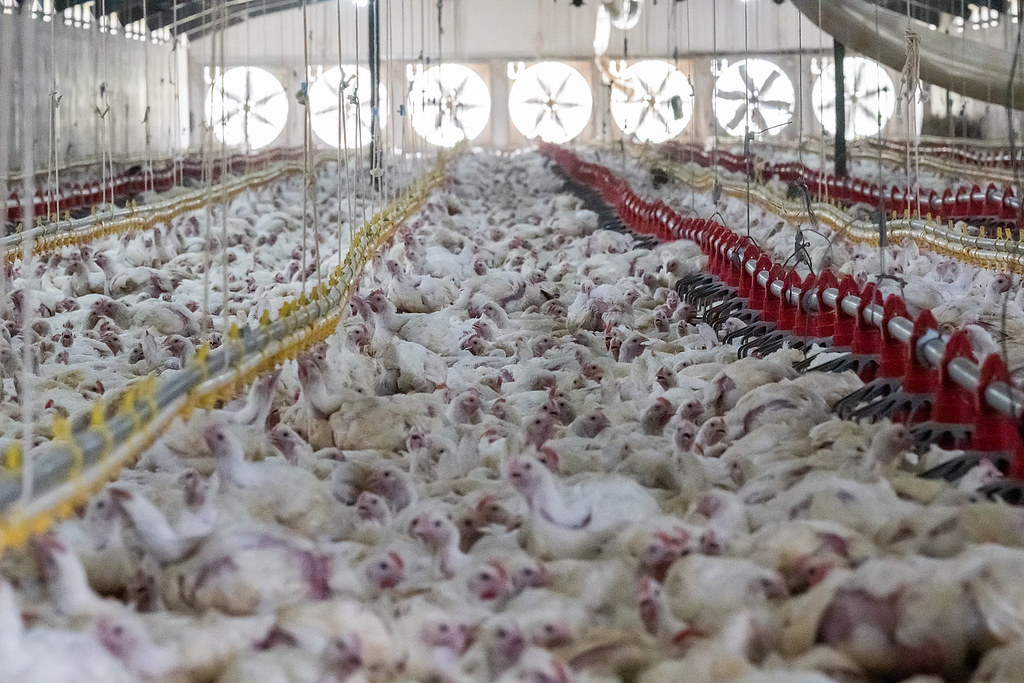
Close to 80% of the world’s soybean crop is not eaten by people. Instead, it is crushed, processed, and fed to the chickens, pigs, and cattle confined in the world’s factory farms. When we talk about the environmental impact of meat, dairy, and eggs, we often focus on the animals themselves—the methane from burping cows, the manure lagoons from pig farms. But these are only part of the story. To truly understand the footprint of industrial animal agriculture, we must look at its foundation: the staggering amount of land, water, and resources required to grow food for the animals, not for the people.
The Great Inversion: When Food Became Feed
The scale is difficult to comprehend. Globally, about a third of all cropland is used to grow animal feed. In the European Union, the figure is over 60%. These are not small, marginal plots of land; these are vast, arable lands, often in ecologically critical regions, dedicated to producing crops for livestock. The two titans of the feed industry are corn and soy. They are grown in staggering quantities, forming the base of a high-protein diet designed to fatten animals for slaughter as quickly and cheaply as possible.
A study published in Science by Joseph Poore and Thomas Nemecek in 2018 provided a landmark analysis, revealing that producing meat and dairy uses 83% of the world’s farmland, yet provides just 18% of our calories and 37% of our protein. The single biggest reason for this incredible inefficiency is the feed. Animals are, in essence, middlemen. For every 100 calories of crops we feed to them, we get back, on average, only about 17-30 calories in the form of pork and chicken, and as little as 3 calories in the form of beef. This "caloric conversion" problem is the fundamental inefficiency at the heart of the system.
The demand for cheap feed has led to the rise of massive monocultures—endless fields of a single crop. This practice, while efficient for industrial harvesting, is devastating for ecosystems. It depletes soil nutrients, increases reliance on chemical fertilizers and pesticides, and eradicates the biodiversity that is essential for a resilient food system.
A Planet-Sized Thirst
Growing crops at this scale requires an astonishing amount of water. The water footprint of animal products is notoriously high, and a huge portion of that is "blue" and "green" water used to irrigate and grow their feed. A single kilogram of beef, for example, can require over 15,000 liters of water when all factors are included. While the cow itself drinks a fraction of this, the vast majority is allocated to the corn, soy, and other grains it consumes over its lifetime.
This colossal water usage has profound consequences:
- Aquifer Depletion: In many major agricultural regions, such as the American Midwest (drawing from the Ogallala Aquifer) or the plains of Northern China, groundwater is being pumped out far faster than it can be naturally replenished, largely to grow thirsty feed crops.
- River Diversion: Rivers are dammed and diverted for irrigation, altering entire ecosystems downstream, impacting fish populations, and creating political tensions over water rights.
- Reduced Food Security: In water-scarce regions, the decision to allocate precious water to grow animal feed for export, rather than staple foods for local populations, can create a dangerous dependency and exacerbate food insecurity.
In a world where the World Health Organization estimates that half the world’s population will be living in water-stressed areas by 2025, using our finite water resources to grow feed for livestock is a luxury our planet can no longer afford.

The Deforestation Nexus: From Amazon to Animal
Nowhere is the link between animal feed and environmental destruction clearer than in the Amazon rainforest. The Amazon is being cleared at an alarming rate, and the primary drivers are cattle ranching and soy cultivation. While many soy producers have adhered to a "Soy Moratorium" in the Brazilian Amazon, which prevents the purchase of soy grown on land deforested after 2008, the pressure has simply shifted to other vital ecosystems like the Cerrado, a vast tropical savanna in Brazil that is one of the most biodiverse regions on Earth. A significant portion of this soy is destined for export, shipped to countries in Europe and Asia to be used as high-protein animal feed.
When you see a truck full of chickens on the highway, or walk past the refrigerated meat aisle in the supermarket, the invisible ghost of the cleared rainforest is present. The demand for cheap meat in one part of the world directly fuels the destruction of irreplaceable ecosystems in another. This isn
Sources
- — Our World in Data (2021)
- — Food and Agriculture Organization of the United Nations (2006)
- — United States Environmental Protection Agency (2023)